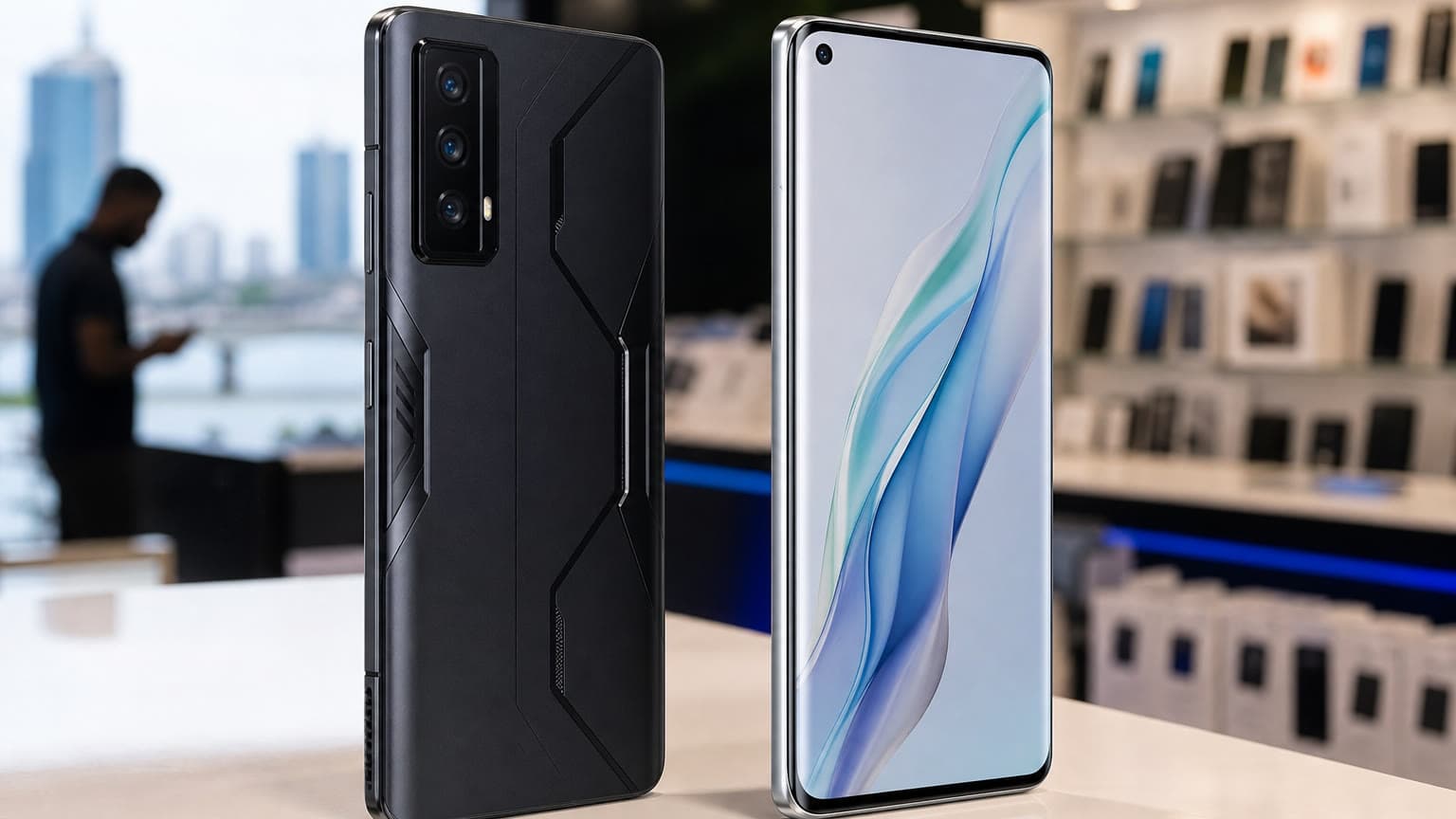
Last reviewed: 14 June 2026. If you are choosing between the Redmi Note 15 Pro+ 5G and the Xiaomi 15T, the short answer is simple: buy the Redmi if battery size, charging speed and lower catalog price matter most; buy the Xiaomi 15T if you want the cleaner camera system, faster storage class and stronger creator-video spec.
Decision summary
This comparison is written for Nigerian and African buyers checking Xiaomi phones by price, availability, warranty, network fit and day-to-day usefulness rather than by headline specs alone. Both phones are large 6.83-inch AMOLED-class devices with 2772 x 1280 resolution, up to 120Hz refresh rate, NFC, USB-C, in-screen fingerprint sensors, dual speakers, 5G support and Xiaomi HyperOS 2 listed by Xiaomi. Both also show stock quantity 0 in the provided Ogabassey catalog snapshot, so treat every price here as a comparison anchor to verify before checkout.
The Redmi Note 15 Pro+ 5G is the more aggressive hardware-value option. Xiaomi lists a Snapdragon 7s Gen 4 processor, 8GB/256GB, 12GB/256GB and 12GB/512GB configurations globally, LPDDR4X RAM, UFS 2.2 storage, a 6500mAh battery, 100W HyperCharge, 200MP OIS main camera, 8MP ultra-wide camera, 32MP front camera, Wi-Fi 6/6E, Bluetooth 5.4 and IP66/IP68/IP69/IP69K ratings. Ogabassey’s provided row starts at ₦612,000, with variants up to ₦683,162.79.
The Xiaomi 15T costs more on the provided Ogabassey row at ₦715,813.95, but it has the more premium internal memory and camera arrangement. Xiaomi lists 12GB RAM with 256GB or 512GB storage globally, LPDDR5X RAM, UFS 4.1 storage, a MediaTek Dimensity 8400-Ultra processor, 5500mAh battery, 67W HyperCharge, Leica triple rear cameras with main, telephoto and ultra-wide lenses, a 32MP selfie camera, Wi-Fi 6E, Bluetooth 6.0 and IP68 resistance.
For most price-sensitive buyers, the Redmi is the better first stop. For creators, business users and buyers who shoot people, products, events or travel often, the Xiaomi 15T justifies attention because it gives you a dedicated telephoto camera and better listed video options. The decision is not just Redmi versus Xiaomi; it is battery-and-charging value versus camera-and-storage polish.
Quick verdict table
| Buyer question | Better pick | Why it matters |
|---|
| Lowest listed Ogabassey entry price? | Redmi Note 15 Pro+ 5G | The provided row starts at ₦612,000 versus ₦715,813.95 for Xiaomi 15T. |
| Longest paper battery advantage? | Redmi Note 15 Pro+ 5G | 6500mAh and 100W charging beat 5500mAh and 67W charging on the Xiaomi 15T. |
| Best camera flexibility? | Xiaomi 15T | It has main, telephoto and ultra-wide rear cameras instead of main plus ultra-wide only. |
| Best storage technology? | Xiaomi 15T | Xiaomi lists UFS 4.1 and LPDDR5X, while the Redmi listing uses UFS 2.2 and LPDDR4X. |
| Best for creator video? | Xiaomi 15T | It lists rear 4K at 60fps and front 4K at 30fps; the Redmi tops out at rear 4K at 30fps and front 1080p. |
| Best durability rating on paper? | Redmi Note 15 Pro+ 5G | It lists IP66, IP68, IP69 and IP69K; the Xiaomi 15T lists IP68. |
| Best if stock is uncertain? | Check both first | Both provided rows show stock quantity 0, so live availability and selected variant matter more than spec preference. |
Price and value in Nigeria
The Redmi Note 15 Pro+ 5G is the better price-value pick from the provided catalog data. Its ₦612,000 starting row is about ₦103,814 lower than the Xiaomi 15T row. That gap can pay for a proper case, screen protector, delivery, a spare cable or part of a future repair reserve. In a market where exchange rates and supplier availability can move quickly, a phone with the better spec sheet is not automatically the better buy if its live price jumps or only a less suitable variant is available.
For Nigerian buyers, the Redmi’s value argument is strongest if the selected unit is the 12GB/512GB variant at a reasonable price. If the available Redmi unit is only 8GB/256GB, it is still a strong battery phone, but the Xiaomi 15T becomes more attractive for people who keep years of WhatsApp media, offline videos, course files, product photos and editing apps on one device.
The Xiaomi 15T asks for more money, but part of that premium is easy to understand. Faster storage class, LPDDR5X memory and a Leica triple-camera arrangement make it a more complete upper-midrange phone. Comparable reviews also flag the Xiaomi 15T as a strong all-rounder, while reviews of the Redmi Note 15 Pro+ 5G praise its display, battery and charging but raise concerns about software feel, older storage class and the missing telephoto camera. Those review findings do not replace Ogabassey’s catalog facts, but they do support a practical buyer warning: the Redmi is not automatically the better premium phone just because it has a bigger battery and a 200MP main camera.
Performance, storage and daily use
On chipset alone, both phones sit above basic budget territory. The Redmi uses Snapdragon 7s Gen 4, while the Xiaomi 15T uses Dimensity 8400-Ultra. Without Ogabassey lab testing, this article should not claim measured frame rates, benchmark wins or thermal results. What the official specs do show is a more premium memory and storage setup on the Xiaomi 15T. UFS 4.1 and LPDDR5X matter for app loading, large file handling and general responsiveness over time, especially for buyers who keep a phone for several years.
The Redmi can still be a sensible daily phone for students, commuters, field workers and family buyers. A large screen, big battery, fast charging and 5G support are exactly the things many people notice every day. It is a good fit for calls, banking apps, WhatsApp, TikTok, YouTube, maps, hotspot use and occasional gaming. The caution is that the Redmi’s global spec uses UFS 2.2 storage, so buyers expecting flagship-like speed should keep expectations realistic.
The Xiaomi 15T is the stronger choice for heavier multitasking and content storage. If you run a small business from your phone, shoot many product clips, keep Lightroom or CapCut projects, save lectures offline, or travel often, the fixed Ogabassey 12GB/512GB row is easier to understand. There is less variant confusion, and the faster storage class gives it a better long-term feel on paper.
Battery, charging, display and durability
Battery is the Redmi’s clearest win. A 6500mAh listed cell is meaningfully larger than the Xiaomi 15T’s 5500mAh battery. Real battery life depends on signal strength, brightness, mobile data, hotspot use, gaming and background apps, but a 1000mAh paper advantage is still useful for buyers dealing with long commutes, unstable power, campus days, market work or field sales.
Charging also favors the Redmi. Xiaomi lists 100W HyperCharge and a 100W in-box charger for the Redmi Note 15 Pro+ 5G, while the Xiaomi 15T lists 67W HyperCharge and recommends a Xiaomi 67W adapter or above. The official pages also warn that package contents can differ by region. That is important for imported stock: confirm charger inclusion, plug type and warranty before paying. A fast-charging phone loses part of its value if the included charger is missing, non-original or inconvenient for your socket setup.
Display is close enough that it should not decide the purchase alone. Both phones list a 6.83-inch AMOLED panel, 2772 x 1280 resolution, 447ppi, up to 120Hz refresh rate and 3200-nit peak brightness. The Redmi uses Corning Gorilla Glass Victus 2 on its listed page, while the Xiaomi 15T lists Gorilla Glass 7i. Both should feel like a major screen upgrade from older budget phones, especially for reading, streaming, football highlights, maps and editing photos.
Durability looks stronger for the Redmi on paper because of its IP66, IP68, IP69 and IP69K ratings. The Xiaomi 15T is still IP68-rated. Neither should be treated as waterproof for careless use. Xiaomi’s official notes warn that water resistance is based on lab conditions, can deteriorate with wear or disassembly, and may not cover liquid damage outside test conditions. In practical terms, use a case, avoid beach or pool exposure, do not charge when wet and protect the charging port.
Camera and video
The Redmi Note 15 Pro+ 5G is built around a 200MP OIS main camera and an 8MP ultra-wide camera. That main sensor is the headline feature, and it suits buyers who mostly shoot people, documents, family moments, food, outdoor scenes and products using the main camera. OIS is useful for steadier shots, and the high-resolution sensor can help with cropping in good light.
The Xiaomi 15T is the better camera-system phone. It lists a 50MP Leica main camera with OIS, a 50MP Leica 46mm telephoto camera and a 12MP Leica ultra-wide camera. That telephoto lens matters more than many buyers expect. It helps for portraits, weddings, church events, school ceremonies, stage events, product images and travel shots where you cannot walk closer. The Redmi can crop from the main sensor, but crop zoom is not the same as having a dedicated telephoto perspective.
Video also favors the Xiaomi 15T. Its rear camera can record 4K at 30fps or 60fps, and its front camera can record 4K at 30fps. The Redmi lists rear 4K at 30fps and front video at 1080p. For TikTok, Instagram Reels, YouTube Shorts, business promos and front-camera creator work, that gives the Xiaomi 15T a clearer advantage. If video matters, do not choose only by megapixel count.
Network, software and warranty checks
Both phones support 5G, 4G, 3G and 2G on broad global bands, with NFC and eSIM notes in Xiaomi’s official specs. In Nigeria, 5G is worth paying for only if your carrier, plan and daily locations support it reliably. If you spend most of your time in a strong 4G area, battery, storage, camera, warranty and repair confidence are more important than 5G alone.
Software support is a real 2026 buying issue. Reviews and support-policy discussions point to four Android OS updates and six years of security support for the Redmi Note 15 Pro series and Xiaomi 15T class, but Ogabassey should still phrase this carefully because support length can vary by region, model and policy page. The practical advice is to confirm the model region, global ROM status and update channel before buying. Avoid unclear imports where banking apps, Google services, eSIM or OTA updates may become a headache.
Warranty and originality checks should happen before payment. Ask whether the unit is new, sealed, global or regional, what warranty applies, whether the charger is included, whether returns are accepted for factory faults, and whether the exact RAM/storage/color variant matches the listing. Because both provided rows show stock quantity 0, live availability should be checked directly from the product page, not assumed from this article.
Repairability also matters. The Redmi’s large battery and 100W charging make battery health and charging-port care important. The Xiaomi 15T’s Leica camera stack may cost more to repair if damaged. Ogabassey’s Phone Repairs section is the sensible starting point for repair conversations, but this article does not claim part availability or repair turnaround because the candidate data does not provide that evidence.
Who should buy each phone?
Buy the Redmi Note 15 Pro+ 5G if battery and value come first
Choose the Redmi if you want the lower listed price, bigger 6500mAh battery, faster 100W charging, broader water and dust rating set, large 120Hz AMOLED display and 200MP OIS main camera. It fits students, commuters, field workers, hotspot users, heavy mobile-data users and family buyers who want a strong Xiaomi spec sheet without paying deeper premium money.
Buy the Xiaomi 15T if camera range and storage feel more important
Choose the Xiaomi 15T if you want 12GB RAM and 512GB storage on the Ogabassey row, faster UFS 4.1 storage, Leica triple rear cameras, a dedicated telephoto lens, stronger video options and a lighter 194g build. It fits creators, event shooters, small-business owners, travelers and buyers who will actually use the telephoto lens and larger storage.
Alternatives to consider
If both rows remain unavailable, start with the wider Ogabassey Smartphones catalog and compare live Xiaomi, Samsung, Tecno, Infinix and Google Pixel availability. If the Redmi Note 15 Pro+ 5G stretches your budget, check whether the Redmi Note 15 Pro or Redmi Note 15 is available at a better price. The non-plus Redmi Note 15 Pro keeps a large battery and 200MP OIS camera theme, but it is not the same phone as the Pro+ and should not be treated as a direct substitute without checking 5G, chipset, charging and variant details.
If you are comparing older Redmi value, the Redmi Note 14 Pro 5G and Redmi Note 14 Pro may still matter when pricing is favorable. For a Xiaomi 15T-only view, read Ogabassey’s Xiaomi 15T in Nigeria buying guide. If you are weighing another Redmi camera phone against the Xiaomi 15T, the Redmi Note 14 Pro 5G or Xiaomi 15T comparison is the better follow-up.
Final verdict
The Redmi Note 15 Pro+ 5G wins for battery, charging and listed value. It is the better buy for most practical Nigerian shoppers if the live variant and warranty are right. The Xiaomi 15T wins for camera flexibility, storage class and creator video. It is the smarter upgrade if you need telephoto framing, 4K selfie video, faster storage and a more polished upper-midrange setup.
Do not buy either phone from a stale price alone. Confirm stock, exact RAM/storage variant, color, charger, warranty, regional ROM, return terms and delivery timeline. If all those checks pass and your priority is power endurance, pick the Redmi. If your phone doubles as your camera and work device, pick the Xiaomi 15T.
FAQ
Which is better for battery, Redmi Note 15 Pro+ 5G or Xiaomi 15T?
The Redmi Note 15 Pro+ 5G is better on paper for battery. It lists 6500mAh and 100W charging, while the Xiaomi 15T lists 5500mAh and 67W charging.
Which phone is better for creators?
The Xiaomi 15T is the stronger creator pick because it has Leica main, telephoto and ultra-wide rear cameras, rear 4K at 60fps and front 4K at 30fps. The Redmi is still good for buyers who mainly use the rear main camera and want better battery value.
Is 5G worth paying extra for in Lagos or Abuja?
5G is worth considering if your network, plan and daily locations support it reliably. Since both phones support 5G, compare price, storage, warranty, camera and battery first.
Should I buy if Ogabassey shows stock quantity 0?
No. Use the listed prices for comparison, then confirm live stock, selected variant, color, charger and warranty before checkout. The provided snapshot shows stock quantity 0 for both phones.
Sources