Bassey John is a Performance Marketing Specialist at Ogabassey with cross-industry experience spanning e-commerce, gaming, and real estate. He focuses on paid acquisition, conversion-rate optimisation, and data-driven growth strategy, turning campaign performance into measurable revenue. At Ogabassey he writes about consumer technology, product buying guides, and the Nigerian gadget market to help shoppers make confident, informed decisions.
If your priority is gaming performance and smoother motion, the Infinix GT 30 Pro is the stronger pick. If you want the lower starting price, bigger battery, curved AMOLED display, NFC, stereo speakers and a newer listed Android version, the Infinix Note Edge is the better value for most Nigerian buyers.
Decision Summary
This is a catalog-verified and official-source-backed comparison, not a hands-on lab review. Ogabassey lists both phones as new Infinix 5G smartphones with 6.78-inch AMOLED-class displays, 45W charging and 10 units shown at row level. The buying decision is not simply “which one is newer” or “which one has the bigger megapixel number.” It is about whether you should spend extra for the GT 30 Pro’s gaming-oriented Dimensity 8350, 12GB RAM and 144Hz display, or save money with the Note Edge’s 6500mAh battery, 120Hz curved AMOLED, Android 16 listing and richer everyday feature sheet.
The quick verdict: buy the GT 30 Pro if you play demanding games, care about higher refresh rate, want 12GB RAM, or prefer a performance-focused phone with 256GB storage fixed in the catalog row. Buy the Note Edge if your phone is mainly for commuting, school, social media, calls, video, mobile banking, hotspot use and long days away from a wall socket. The Note Edge is also easier to recommend to family buyers because the lower starting price leaves more budget for a case, screen protector, charger checks and after-sale support.
For shoppers comparing Infinix phones broadly, the wider Ogabassey smartphones catalog is still worth checking before checkout because prices and storage variants can change. If you are coming from older Note models, Ogabassey’s Infinix Note 50 buying guide gives useful context on why battery, display and storage often matter more than chasing one headline feature.
Price and Value in Nigeria
On the provided Ogabassey snapshot, the Infinix GT 30 Pro is listed at ₦549,700 for 12GB RAM and 256GB storage. The Infinix Note Edge starts at ₦417,300, with variant prices shown from ₦417,300 to ₦463,500 depending on the selected storage and colour option. That creates a meaningful gap: at the lowest listed Note Edge price, the GT 30 Pro costs ₦132,400 more. Even against the highest listed Note Edge variant, the GT 30 Pro still costs ₦86,200 more.
That extra money buys the GT 30 Pro a stronger performance position on paper: Dimensity 8350, 12GB RAM, 256GB storage, 144Hz AMOLED gaming display and a 108MP main camera listing. For a gamer, creator or heavy multitasker, those are understandable reasons to pay more. But for a student, office worker, family buyer or everyday 5G user, the Note Edge’s lower entry price is hard to ignore because it still has 5G, an AMOLED display, 45W charging, 8GB RAM, 128GB or 256GB storage options and a larger 6500mAh battery.
In Nigeria, price/value also includes practical costs after purchase. A curved display can be more expensive to protect and potentially more sensitive to edge damage if the phone drops without a good case. A gaming-focused device may draw buyers who push performance harder, which makes heat, charging habit and battery care more important over time. Neither phone should be bought only from a spec line; confirm the exact variant, colour, storage, charger package, warranty path and live availability on Ogabassey before paying.
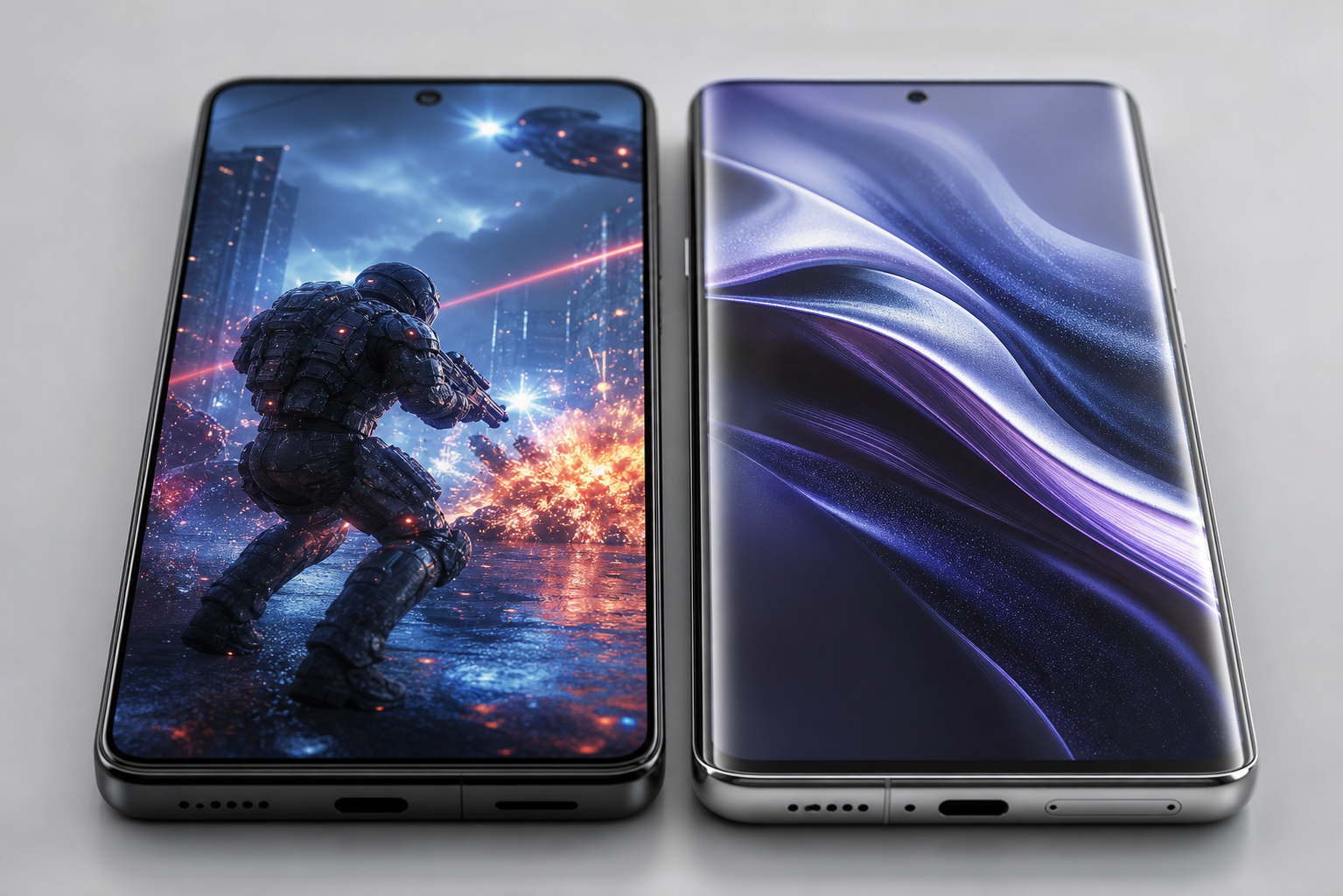
The display decision comes down to 144Hz gaming smoothness versus a curved AMOLED everyday design.
Comparison Scorecard
Buyer question
Infinix GT 30 Pro
Infinix Note Edge
Practical winner
Ogabassey listed price
₦549,700
₦417,300 row price; variants up to ₦463,500
Note Edge
RAM and storage
12GB RAM, 256GB storage
8GB RAM, 128GB or 256GB storage options
GT 30 Pro for multitasking; Note Edge for flexible budget
Chipset
Dimensity 8350
MediaTek Dimensity 7100
GT 30 Pro
Display
6.78-inch 1.5K AMOLED gaming display
6.78-inch 1.5K 3D curved AMOLED
GT 30 Pro for gaming; Note Edge for curved premium feel
Refresh rate
144Hz
120Hz
GT 30 Pro
Battery
5500mAh
6500mAh
Note Edge
Charging
45W
45W
Tie
Main camera
108MP listed rear camera
50MP listed rear camera
GT 30 Pro on resolution; real output still needs review evidence
Front camera
13MP
13MP
Tie
5G
Yes
Yes, with 5G SA/NSA and Dual 4G VoLTE listed
Note Edge has more network detail listed
Software listing
Android 15
Android 16 with XOS 16
Note Edge on listed version
Durability extras
Not listed in catalog specs
IP65 and Gorilla Glass 7i listed
Note Edge
NFC
No listed NFC
NFC listed
Note Edge
Audio
Stereo speakers not listed
Stereo speakers listed
Note Edge
Best fit
Mobile gaming, performance, high refresh AMOLED
Battery life, curved display, everyday 5G value
Depends on use case
Performance and Daily Use
The GT 30 Pro is the clearer performance phone. Its Dimensity 8350 and 12GB RAM give it the better catalog position for high frame-rate games, switching between heavier apps and keeping a phone for users who dislike performance compromise. The 144Hz display also matters if you play games that can benefit from higher refresh rates or if you simply like very smooth scrolling. Ogabassey’s row recommends it for mobile gaming, high-refresh AMOLED, large battery and performance phone use, which matches the spec direction.
The Note Edge is not weak on paper, but it is positioned differently. Its Dimensity 7100, 8GB RAM and 120Hz AMOLED should be enough for WhatsApp, Instagram, TikTok, Chrome tabs, mobile banking, email, light editing and casual games. The issue is expectation: if you are buying mainly for gaming and want the highest Infinix performance in this pair, the Note Edge is the compromise. If you are buying for normal daily use and want the phone to last through more hours between charges, the Note Edge looks more balanced.
For Nigerian 5G buyers, both phones list 5G support, but coverage still depends on your city, your network, your SIM plan and your exact location. In Lagos, Abuja, Port Harcourt or other better-covered areas, 5G can be useful for downloads, hotspot use and lower congestion in some spots. But 5G alone should not decide this comparison. If you spend more time on Wi-Fi, 4G VoLTE calls and messaging, the battery and storage choice may affect your daily experience more than the 5G badge.
Battery, Display and Build
Battery is the Note Edge’s biggest win. Its 6500mAh battery is 1000mAh larger than the GT 30 Pro’s 5500mAh pack, while both phones list 45W charging. A larger battery does not automatically mean every user gets the same extra hours, because brightness, gaming, hotspot use, weak signal areas and battery health all matter. Still, for a Nigerian buyer who may be away from steady power for long stretches, 6500mAh is a practical advantage.
The display choice is more nuanced. The GT 30 Pro has a 1.5K AMOLED gaming display with a 144Hz refresh rate. That is the one to choose for smoother motion and a gaming-first feel. The Note Edge has a 6.78-inch 1.5K 3D curved AMOLED display with 120Hz refresh, plus a listed 4500-nit peak brightness and Gorilla Glass 7i protection. The curved panel can feel more premium and immersive, but buyers should budget for proper protection because edge glass repairs can be less forgiving than flat-screen repairs.
The Note Edge also lists IP65, NFC, stereo speakers, reverse charging, USB Type-C, in-display fingerprint, Wi-Fi 802.11ac and Bluetooth 5.4. Several of those fields are not listed for the GT 30 Pro in the provided catalog data. That does not prove the GT 30 Pro lacks every unlisted feature in every market, but it does mean a cautious buyer should verify them before checkout. For support and repair questions, the safer article language is simple: buy from the specific row and confirm the exact regional SKU, charger, network bands and warranty handling.
Before paying, confirm storage, colour, charger, warranty route, network bands and live availability.
Camera and Content Creation
The GT 30 Pro has the stronger camera headline with a 108MP rear camera and 13MP front camera. The Note Edge lists a 50MP rear camera and 13MP front camera, with 2K at 30fps video listed for both rear and front cameras. On paper, the GT 30 Pro should attract buyers who want more resolution for daylight shots and cropping. But megapixels do not prove better night photos, skin tones, autofocus, stabilization or social-media video quality without hands-on testing.
For creators, the smarter choice depends on the work. If you shoot casual TikTok clips, school projects, product photos in daylight and everyday portraits, the Note Edge may be enough, especially if the saved money helps you buy lighting, a tripod or a better protective setup. If you game, stream, edit short clips and want stronger performance headroom, the GT 30 Pro is the more sensible upgrade. Because Ogabassey does not provide lab camera samples here, this draft should not claim one phone has the better real-world camera output.
Availability, Warranty and Repair Risk
Both rows show stock quantity 10 in the provided snapshot, but buyers should treat that as a catalog signal, not a permanent guarantee. Confirm live availability, selected colour, storage, condition and final price before checkout. For the GT 30 Pro, the listed colours are Blade White, Shadow Ash and Dark Flare. For the Note Edge, the listed colours are Lunar Titanium, Shadow Black, Silk Green and Stellar Blue, with storage options of 128GB and 256GB.
Warranty trust matters more than many spec comparisons admit. New phones should be checked for sealed condition, IMEI consistency, receipt details and the exact after-sale process. Import risk is also relevant because Infinix configurations can vary by market. A buyer should confirm model number, charger rating, network bands and whether features such as NFC, reverse charging or bundled accessories apply to the exact unit being sold. If damage happens later, the Ogabassey phone repairs page is the sensible starting point for repair guidance, but this article does not claim parts availability or fixed repair pricing for either model.
Who Should Buy Each Option?
Buy the Infinix GT 30 Pro if performance is the main reason you are upgrading
Choose the GT 30 Pro if you play games regularly, care about a 144Hz AMOLED display, want 12GB RAM, prefer 256GB storage without choosing between storage tiers, or plan to keep many apps open. It is also the better fit if your search is specifically “Infinix GT 30 Pro price in Nigeria” and you already know you want a gaming-oriented Infinix rather than the cheaper all-rounder.
Buy the Infinix Note Edge if value and battery are more important
Choose the Note Edge if your top priorities are lower price, a 6500mAh battery, curved AMOLED design, Android 16 listing, NFC, stereo speakers and a richer everyday feature list. It is the stronger answer for buyers searching “Infinix Note Edge price in Nigeria” or “Infinix Note Edge 5G price in Nigeria” because it keeps 5G and a premium-looking screen while staying below the GT 30 Pro’s price.
Alternatives Worth Considering
If neither phone feels right, stay within the Infinix family first. Buyers who want a Note-series value phone but do not need 5G should read Ogabassey’s Infinix Note 50 guide. Buyers looking at future or higher Note positioning can also compare the wider Infinix discussion around Infinix Note 60 Pro specs and price in Nigeria. If you are open to other brands, use the main smartphones category to compare Samsung, Tecno, Redmi, Google Pixel and iPhone options by budget, condition and availability.
Verdict
The Infinix GT 30 Pro wins the performance side of this comparison because the scorecard rows for chipset, RAM/storage and refresh rate all favour it: Dimensity 8350, 12GB RAM with 256GB storage, and a 144Hz AMOLED gaming display. The Infinix Note Edge wins the everyday-value side because the price, battery, software listing and feature rows lean its way: lower starting price, 6500mAh battery, Android 16 listing, IP65, NFC and stereo speakers. For most Nigerian buyers, the Note Edge is the better value. For mobile gamers and performance-first buyers, the GT 30 Pro is the one worth paying extra for.
FAQ
Which is better, Infinix GT 30 Pro or Infinix Note Edge?
The GT 30 Pro is better for gaming and performance because it lists a Dimensity 8350, 12GB RAM and 144Hz display. The Note Edge is better for value and battery life because it starts lower, lists a 6500mAh battery, Android 16, NFC, stereo speakers and IP65.
Is 5G worth paying extra for in Lagos or Abuja?
5G can be useful in better-covered parts of Lagos, Abuja and other cities, especially for downloads and hotspot use. But both phones already list 5G, so the real decision here is not 5G versus no 5G. It is performance and 144Hz on the GT 30 Pro versus price and battery on the Note Edge.
Which phone has better battery life on paper?
The Infinix Note Edge has the stronger battery spec on paper with 6500mAh, compared with 5500mAh on the GT 30 Pro. Both list 45W charging. Real endurance still depends on screen brightness, signal strength, gaming, hotspot use and charging habits.
Should I buy the 128GB or 256GB Note Edge?
Choose 256GB if you save many videos, offline movies, WhatsApp media, games or school files. Choose 128GB only if the lower price matters more and you regularly clean storage or use cloud backups. The GT 30 Pro row in this snapshot is already listed as 256GB.
Catalog-linked prices update automatically. Historical and other quoted prices remain as written. Open the product page to confirm the current price, selected variant and availability before buying.