Bassey John is a Performance Marketing Specialist at Ogabassey with cross-industry experience spanning e-commerce, gaming, and real estate. He focuses on paid acquisition, conversion-rate optimisation, and data-driven growth strategy, turning campaign performance into measurable revenue. At Ogabassey he writes about consumer technology, product buying guides, and the Nigerian gadget market to help shoppers make confident, informed decisions.
The iPhone 18 Pro Max is the better choice for screen space and Apple’s rated battery endurance; iPhone 18 Pro offers the same core camera platform in a smaller body. For Nigerian buyers, the smarter purchase also depends on the actual naira quote, storage, import region, SIM compatibility and written warranty terms.
Last reviewed: 26 October 2026. This comparison uses Apple’s published information, external review context and the supplied Ogabassey catalog snapshot. Recommendations are editorial buying advice; Ogabassey has not supplied hands-on testing of these two phones.
What changed with the iPhone 18 Pro launch?
Apple announced both models on 9 September 2026. Pre-orders opened on 12 September in the initial launch markets, with availability from 18 September and another rollout from 25 September. Nigeria is not among the countries explicitly named in the announcement’s initial-market examples; that announcement alone does not establish Nigerian retail availability.
The headline changes include A20 Pro, a variable-aperture main camera, revised cooling and iOS 27. Both sizes share the core Pro camera features. The practical question is therefore whether the Max’s larger body and battery advantage improve your routine enough to justify its price premium.
Apple’s published U.S. starting prices are $1,199 for iPhone 18 Pro and $1,299 for Pro Max, both with 256GB. These are U.S. reference prices, not Nigerian offers. Dollar conversion alone leaves out sourcing costs, taxes, delivery, exchange-rate changes and seller support.
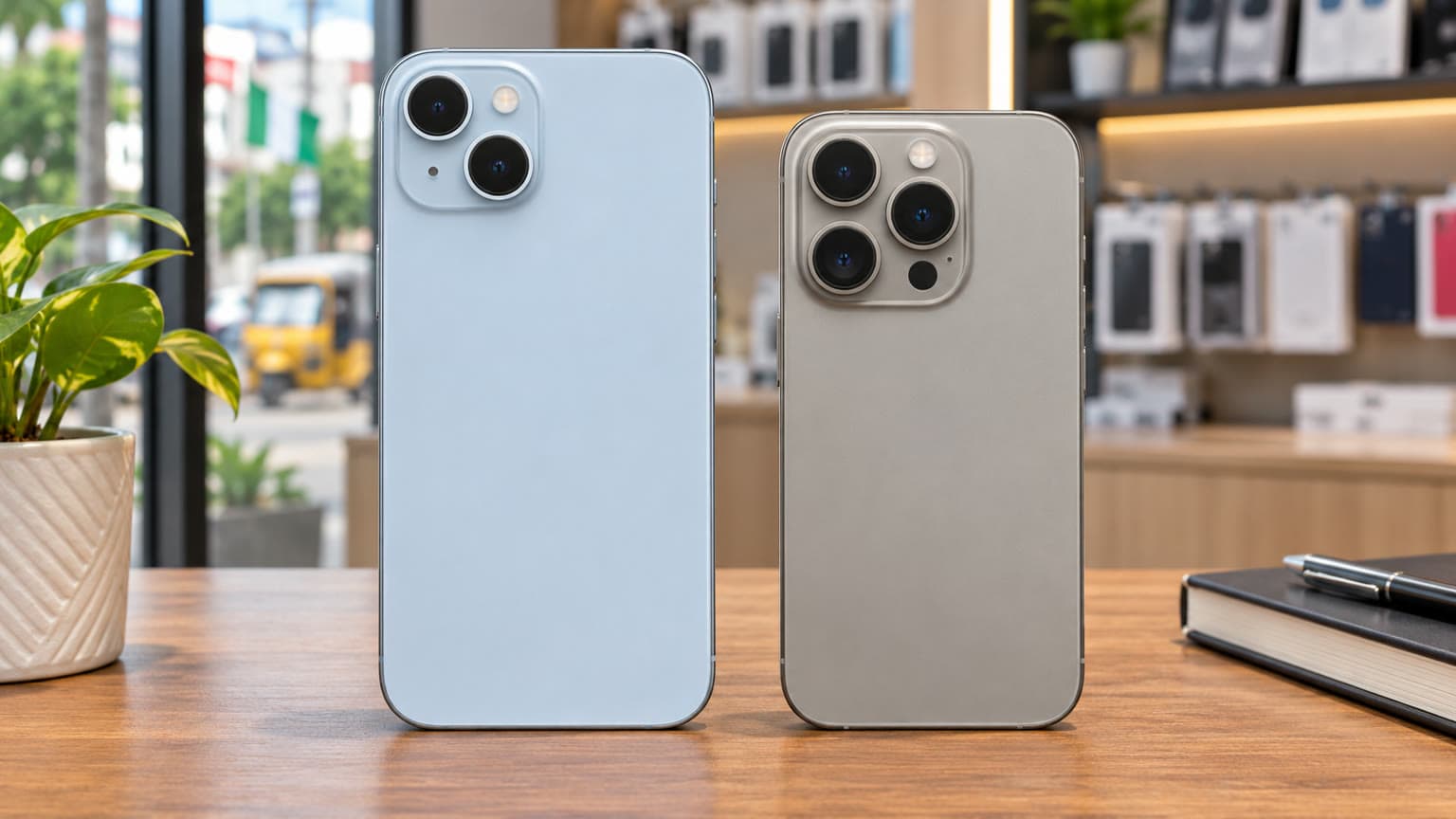
The smaller Pro is easier to carry; the Pro Max gives more screen room for video, maps and editing.
iPhone 18 Pro vs iPhone 18 Pro Max: decision table
Decision point
iPhone 18 Pro
iPhone 18 Pro Max
Buyer implication
Display
6.3-inch OLED; 2622 × 1206
6.9-inch OLED; 2868 × 1320
Choose screen space or easier handling.
Dimensions
150.0 × 71.9 × 8.75mm
163.4 × 78.0 × 8.75mm
Try the larger footprint before committing.
Weight
211g
249g
Max adds 38g before a case.
Rated video playback
Up to 36 hours
Up to 45 hours
Max has greater rated endurance.
Rated streamed video
Up to 33 hours
Up to 40 hours
These are controlled manufacturer ratings.
Storage
256GB, 512GB, 1TB, 2TB
256GB, 512GB, 1TB, 2TB
Choose capacity independently of size.
Core platform
A20 Pro; iOS 27
A20 Pro; iOS 27
Size does not buy a different software generation.
Rear cameras
48MP main, ultrawide and telephoto
Same core camera configuration
Max is not required for the headline camera tools.
Display, comfort and everyday performance
Both displays offer ProMotion adaptive refresh rates up to 120Hz and an Always-On mode. For scrolling, reading and ordinary social apps, screen size is the more useful distinction than resolution: the smaller phone is already sharp, while the larger one gives documents, maps and editing controls more room.
Before choosing Max, imagine carrying it through a full working day with a protective case. Pocket depth, hand size and the reach to the top of the screen matter more than a showroom impression. Students and commuters who hold their phone while standing may prefer the smaller Pro even when they can afford either.
Shared silicon does not guarantee identical temperatures or sustained performance in every workload. Neither the common chip name nor a larger enclosure proves a gaming advantage without comparable testing. Buy around the apps you actually use, rather than assuming the larger model must always be faster.
Battery and charging: where Pro Max earns its premium
The Max’s rated advantage is useful for long journeys, navigation and days away from reliable charging. However, video-playback figures are not promises of equivalent hours using mobile data, hotspot, camera recording or gaming. Signal quality, brightness, temperature and background activity all change endurance.
For Nigerian buyers dealing with irregular access to power, extra battery headroom can be more useful than another camera feature. Balance that against weight: a smaller phone plus a suitable power bank may fit your routine better, especially if you already carry a bag.
Apple advertises approximately 50% wired charging in 15 minutes with a compatible 60W-capable or higher adapter supporting Adjustable Voltage Supply. That is an adapter requirement for a conditional charging claim, not proof that the phone continuously draws 60W. The box includes a USB-C cable; budget separately for a suitable adapter.
Check charger protocol support rather than wattage alone. A high number printed on an inexpensive adapter does not establish compatibility. For a desk or bedside setup, also consider cable length, heat and whether the charger must power a laptop at the same time.
Camera, video, storage and RAM
The shared variable-aperture main camera is a reason to consider this generation, rather than a reason to select Max. Aperture control offers another tool for balancing light and depth of field, but better results still depend on focus, lighting, subject movement and how you shoot.
For product sellers, event creators and families, decide whether you will use the extra controls. If most output goes straight to WhatsApp or social platforms, a recent older iPhone may already meet your needs. A larger display can make reviewing footage easier, but it does not create a separate camera tier.
Tom’s Guide reports 12GB RAM in both models. Apple’s public specification page does not publish a RAM figure, so treat this as a review-reported specification, not an Apple-listed purchasing option. Buyers select storage capacity; they do not choose a separate RAM upgrade at checkout.
Check your current storage usage before ordering. Allow space for app growth, offline media and future recordings. Choose 512GB or more if you routinely keep substantial video locally; otherwise, paying for unused capacity can weaken value. Cloud storage has recurring costs and needs a dependable upload connection.
Professional video workflows also need an accessory budget. Verify recording-format requirements, external-drive compatibility and cable speed before purchasing equipment. A USB-C connector describes the plug shape; it does not guarantee that every cable transfers large video files equally quickly.
Nigeria availability, warranty and price context
The supplied data includes an iPhone 18 Pro Max sales signal, but it does not provide a complete current offer for both models with matched storage, condition, region and warranty. Historical sales demonstrate prior transactions; they do not establish today’s stock or a price for the unit you want.
Request a written quote showing model, storage, colour, condition, regional variant, included accessories, delivery charge and warranty provider. Compare Pro and Max at the same capacity. A cheaper open-box Pro and a sealed Max are different offers, so their price gap cannot be attributed entirely to screen size.
Apple’s limited warranty generally covers manufacturing defects for one year under its applicable terms. Its terms allow iPhone warranty service to be restricted to the country of original sale. An imported phone should therefore come with a clear explanation of who handles a claim, where it goes and who pays transport costs.
Do not interpret a warranty as automatic cover for accidental damage, normal battery wear or every liquid-related fault. Ask about the seller’s return window separately from repair coverage. A return policy determines what happens if the delivered unit is wrong or unsuitable; a warranty addresses covered faults.
Repairability also belongs in the budget. Ask about replacement-screen and battery availability, diagnostic charges and expected turnaround. No verified Nigerian repair prices or parts lead times for these models were supplied, so this guide cannot promise inexpensive or immediate repairs.
Platform, SIM and network compatibility
Apple’s U.S. specifications describe both models as eSIM-only, without physical SIM support. Check the exact imported regional model before payment. “Factory unlocked” concerns carrier restrictions; it does not establish that a phone has a SIM tray or that your chosen carrier can activate your line.
If you use MTN, Airtel or Glo, ask your own network about eSIM eligibility, identity checks, replacement and transfer procedures for your particular line. Do not assume all three networks have identical support. A business line, backup number or travel SIM can make this check more important than the colour you choose.
Apple’s Dual SIM guidance requires compatible carrier support. Using two different carriers also requires an unlocked phone. Dual SIM can separate work and personal numbers, but it does not mean two cellular data connections operate simultaneously.
Both phones support 5G, but paying more for Max does not solve a coverage problem. In Lagos or Abuja, test your carrier where you live, work and commute. Strong 4G can be more useful than inconsistent 5G; coverage, congestion and data-plan costs determine the experience.
Before checkout, Nigerian buyers should verify SIM configuration, storage, charger needs and warranty route.
iOS 27, Apple Intelligence and support expectations
Both models launch with iOS 27 and support Apple Intelligence. Apple’s current guidance ties feature availability to eligible hardware, software, supported languages and regions. Siri AI is identified as beta, so avoid buying solely around a demonstration that may differ from your actual settings or rollout.
Apple Intelligence also supports eligible older devices, including iPhone 16 models and later, plus iPhone 15 Pro and Pro Max. You therefore do not need an iPhone 18 Pro merely to enter Apple’s AI platform. Check the specific feature you want rather than treating every generation as interchangeable.
No fixed end-of-support year for these two models is established here. A newer launch offers a later starting point, but that is not a guaranteed number of future iOS upgrades. Keep backups, install supported updates and assess app compatibility over time.
What to verify before buying new, open-box or used
Identity: match model, storage and serial or IMEI details across the device, invoice and packaging. A serial-number lookup alone does not prove the entire phone is original.
Ownership: a preowned phone should be erased and ready for your activation. Do not buy an Activation Locked device or accept a promise that the previous owner will remove it later.
Condition: clarify whether “UK-used,” open-box or refurbished describes prior use, repairs or merely the sourcing market. These labels are not universal quality grades.
Battery and repairs: review available battery-health information, cycle count and Parts and Service History. Ask for explanations of warnings or replacements.
Functions: test Face ID, touch, cameras, microphones, speakers, charging, Wi-Fi and your cellular line. Record any agreed defect on the invoice.
After-sales support: get return conditions, warranty exclusions and the claim contact in writing before payment.
Older iPhone alternatives and related Ogabassey comparisons
If the iPhone 18 quote stretches your budget, compare the iPhone 17 Pro and iPhone 17 Pro Max first. Previous-generation Pro hardware may leave more money for storage, accessories and dependable seller support.
The iPhone 16 Pro and iPhone 16 Pro Max deserve consideration when their condition and total price are attractive. The iPhone 16 Plus offers another large-phone option, while the iPhone 16 is relevant when ordinary daily use matters more than Pro camera controls.
Also compare the iPhone 17 and iPhone 17e against your actual requirements. The supplied catalog lists these alternatives, but its stock fields and disabled stock management do not reliably confirm availability. Request the selected variant’s current offer.
Choose iPhone 18 Pro when you want the shared Pro platform and prefer easier handling. Choose Max when longer rated endurance and a larger screen solve a daily problem. Compare matched quotes before judging the premium.
Should I upgrade from iPhone 16 or iPhone 17?
Keep your current phone if its battery, camera and storage still meet your needs. Identify a specific limitation before upgrading; a newer model name alone does not establish enough benefit to justify the cost.
Should I consider Samsung, Google Pixel, Xiaomi, Tecno or Infinix?
Yes, if your budget or preferred apps favour Android. Compare similarly priced, locally supported devices rather than assuming every brand serves the same price bracket. Include repair access, warranty, camera preferences and the cost of moving your apps and accessories.
Is Pro Max automatically the safest purchase?
No. A correctly specified Pro with clear ownership and support is a better purchase than a poorly documented Max. Prioritise the right regional unit, comfortable handling and a sustainable total budget.
Sources
Apple debuts iPhone 18 Pro and iPhone 18 Pro Max
Apple: iPhone 18 Pro and iPhone 18 Pro Max Technical Specifications
Apple Support: iPhone 18 Pro Max Technical Specifications
Tom’s Guide: iPhone 18 Pro and Pro Max review
MacRumors: iPhone 18 Pro vs iPhone 18 Pro Max Buyer’s Guide
Apple Support Nigeria: If you want to buy a preowned iPhone
Apple Support Nigeria: Using Dual SIM with an eSIM
Apple One Year Limited Warranty: U.S. terms
Apple Support Nigeria: Get started with the next generation of Apple Intelligence
Catalog-linked prices update automatically. Historical and other quoted prices remain as written. Open the product page to confirm the current price, selected variant and availability before buying.