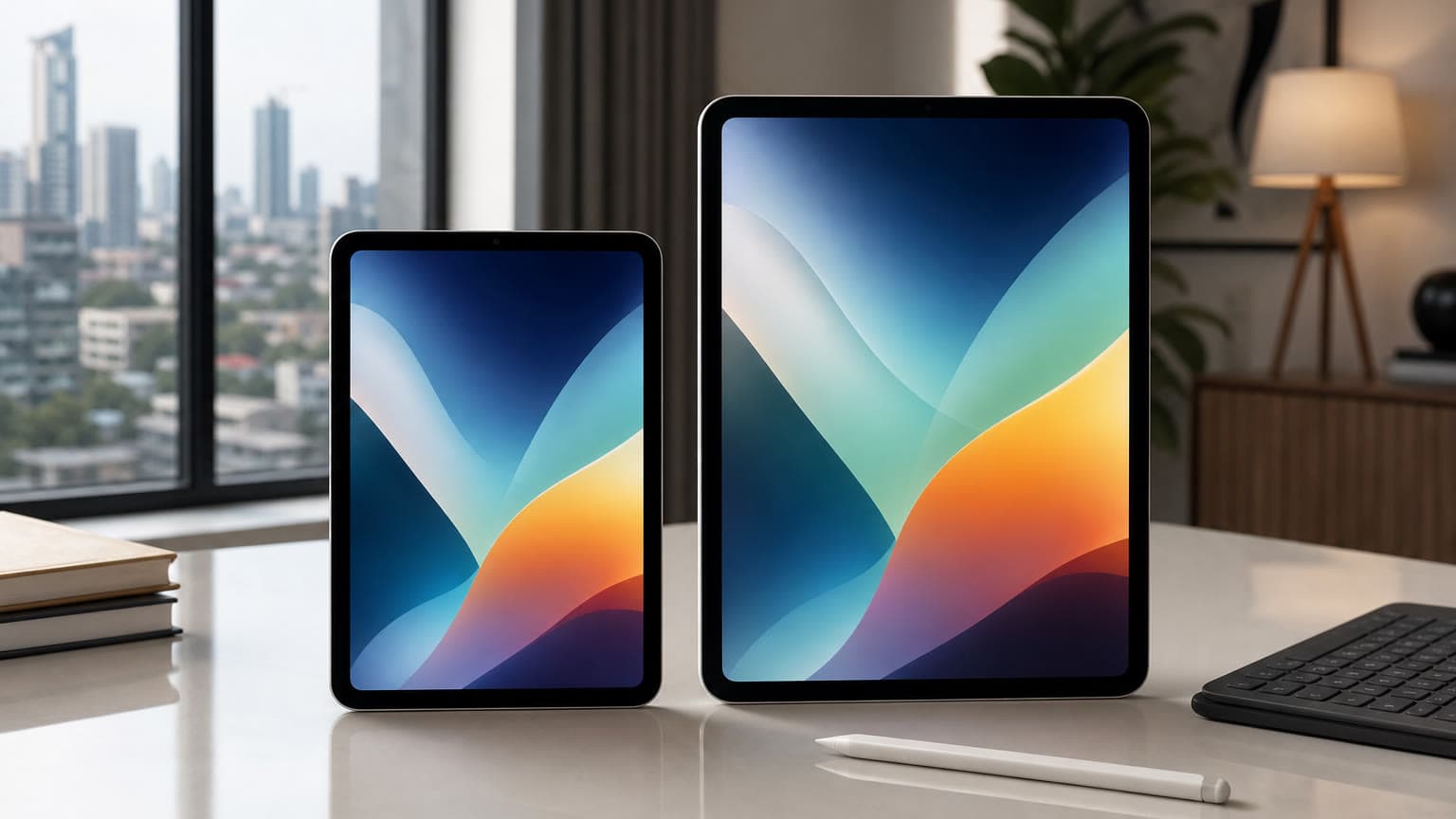
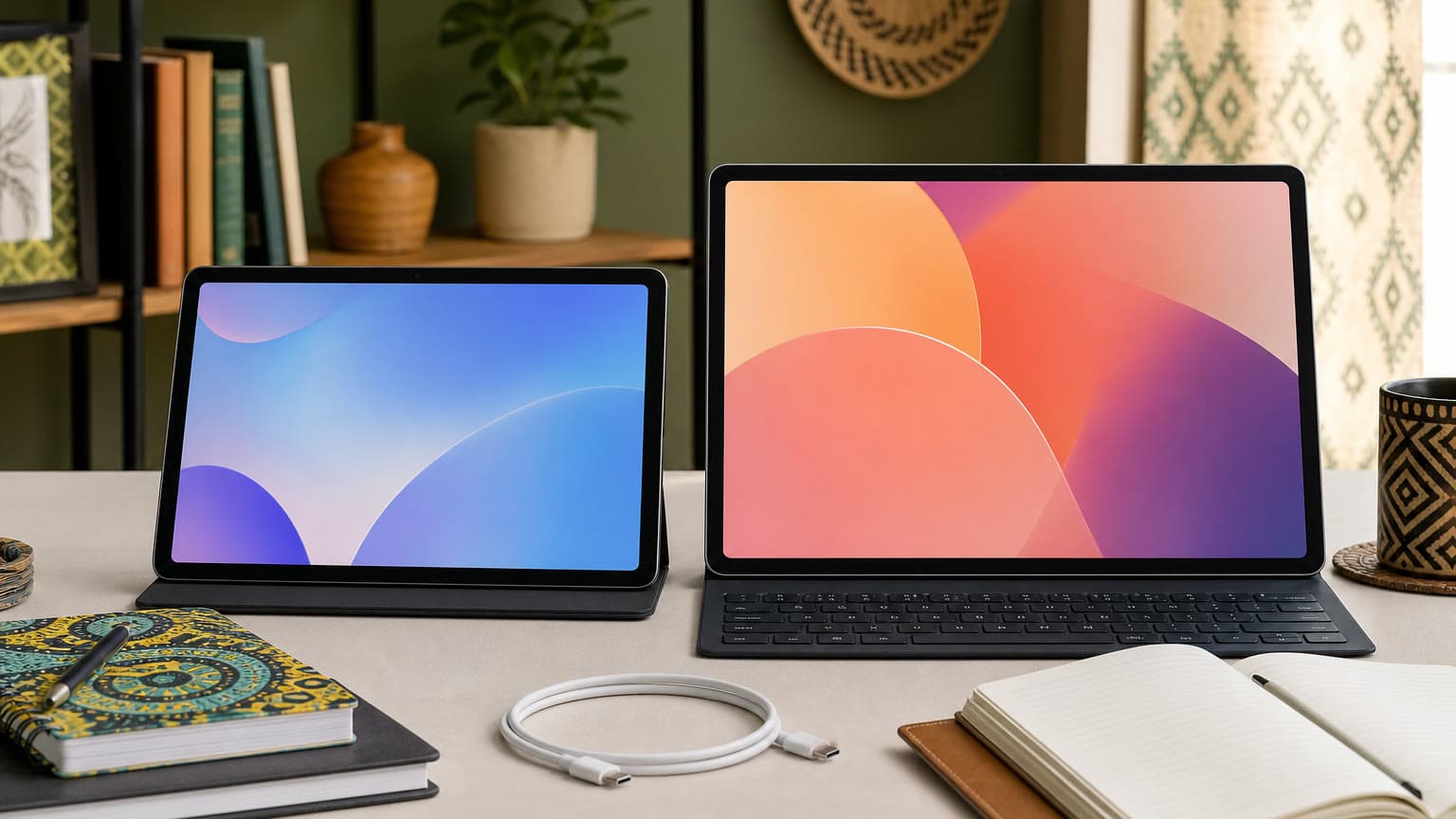
If you want the stronger long-term iPad for creator work, display quality and Apple Pencil Pro support, choose the iPad Pro M4 11-inch. If your budget matters more and you can accept a used unit, the iPad Pro 11-inch M2 is the better-value Pro iPad to check first in Nigeria.
Decision Summary
This comparison is for buyers choosing between two compact Apple Pro tablets on Ogabassey: the iPad Pro 11-inch (M2) and the iPad Pro M4 11-inch. Both are 11-inch Pro iPads with 120Hz displays, Apple silicon, no memory-card slot, no headphone jack and strong accessory potential, but they are not equally sensible for every Nigerian buyer.
The catalog-verified price gap is the first real decision point. The iPad Pro 11-inch (M2) is listed from NGN 930,000 as a used unit, while the iPad Pro M4 11-inch is listed at NGN 1,165,000 as a new unit. That is a NGN 235,000 difference before you add a keyboard, Apple Pencil, case, charger needs or cellular data costs. For students, note-taking, streaming, light design work and general tablet productivity, the M2 model already covers the core Pro iPad experience at a lower entry price.
The M4 model is the cleaner buy when the screen and accessory generation matter. Apple lists the 11-inch iPad Pro M4 with an Ultra Retina XDR display, M4 chip, Apple Pencil Pro support and Magic Keyboard support for iPad Pro M4. The older 11-inch M2 model uses a Liquid Retina display, M2 chip and the previous accessory ecosystem. That does not make the M2 weak; it makes the M4 more future-facing for buyers who plan to keep the tablet for years and use it as a serious creative device.
For live shopping, start from the full Ogabassey Tablets category so you can compare stock, condition and other tablet options before paying. The iPad Pro M4 row currently shows zero stock in the provided snapshot, while the M2 row shows two units. Treat those as catalog snapshot signals, not guaranteed checkout availability; confirm live availability, selected variant, warranty terms and accessory bundle before you commit.
Comparison Scorecard
| Decision point | iPad Pro 11-inch (M2) | iPad Pro M4 11-inch | Buyer impact |
|---|
| Ogabassey condition | Used | New | The M2 can be better value, but inspect condition and warranty carefully. The M4 is cleaner if you prefer new stock. |
| Catalog starting price | NGN 930,000 | NGN 1,165,000 | The M2 saves NGN 235,000 before accessories. |
| Catalog stock snapshot | 2 units | 0 units | The M2 is the more immediately available option in this snapshot, but live availability should be confirmed. |
| Display size | 11.0 inches | 11.0 inches | Both are compact enough for bags, lectures, travel and handheld use. |
| Display type | Liquid Retina | Ultra Retina XDR | The M4 is the better screen choice for creators and buyers who care about HDR-style visual quality. |
| Display resolution | 2388 x 1668 | 2420 x 1668 | Both are sharp 11-inch panels; the M4 has a slightly higher listed resolution. |
| Refresh rate | 120Hz | 120Hz | Both should feel fluid for writing, scrolling and Pencil work. |
| Chipset | Apple M2 | Apple M4 | The M4 is the stronger, newer platform for heavier creative workflows and longer ownership. |
| Storage options in snapshot | 128GB, 256GB, 1TB | 256GB | The M2 listing has more variant range; the M4 starts at a more comfortable 256GB in this snapshot. |
| Connectivity options in snapshot | Wi-Fi, Wi-Fi + Cellular | Wi-Fi + Cellular | The M2 may let buyers choose cheaper Wi-Fi-only variants; the M4 listing is cellular in the snapshot. |
| Rear camera | 12MP | 12MP | Neither should be bought mainly as a camera device; cameras are more for scanning, calls and reference capture. |
| Front camera | 12MP listed | Not listed in snapshot | The M2 catalog row gives a front-camera figure; verify M4 camera details on checkout if video calls matter. |
| Weight | 466g listed | Not listed in snapshot | The M2 has a known catalog weight here; for the M4, confirm exact model details if portability is critical. |
| Memory-card slot | No | No | Buy enough internal storage from the start; you cannot add a microSD card later. |
| Headphone jack | No | No | Budget for USB-C or wireless audio if you use wired headphones. |
| Battery spec style | Apple publishes Wh rather than mAh | Apple publishes Wh rather than mAh | Do not compare these iPads using phone-style mAh claims from unsupported listings. |
The verdict from this table is clear: the biggest differences are price and condition on one side, then display generation, chip generation and accessory generation on the other. The iPad Pro 11-inch (M2) wins the practical value row because it is NGN 235,000 cheaper in the provided catalog snapshot and has stock listed. The iPad Pro M4 wins the premium-use rows because it carries the newer M4 chip and Ultra Retina XDR display.
Price And Value In Nigeria
For many Nigerian buyers, the real budget is not just the iPad price. A Pro iPad becomes more useful when paired with a keyboard, Pencil, protective case, cloud storage and possibly a cellular data plan. That is why the NGN 235,000 gap between these two listings matters. If you are buying for school, business notes, YouTube learning, document markup, Canva-style design, light editing and everyday browsing, the M2 model leaves more room for accessories.
The used condition on the M2 listing is not automatically a problem, but it changes the checks you should make. Confirm battery health expectations where possible, check screen condition, inspect the USB-C port, verify Face ID, test speakers and ask exactly what is included in the box. A used Pro iPad can be excellent value, but only when the condition and warranty/return terms are clear before payment.
The M4 model has a different value argument. It is listed as new, uses Apple’s newer M4 platform and starts with 256GB storage in this snapshot. If you are a designer, illustrator, video editor, architect, photographer, developer who uses the iPad as a side workstation, or a buyer replacing a laptop for some tasks, paying more for the M4 can make sense. You are buying the better screen and the newer iPad Pro accessory generation, not merely a spec bump.
Availability matters too. The provided Ogabassey snapshot shows the M2 with stock quantity 2 and the M4 with stock quantity 0. Because tablet inventory changes, the safe buyer move is to treat this article as decision guidance and then check the live product pages. If the M4 is unavailable when you are ready to buy, compare it with other Pro and premium tablets from the Tablets category rather than forcing a wait with no confirmed restock date.
Performance And Daily Use
The iPad Pro 11-inch (M2) remains far beyond what most tablet buyers need for regular school and office tasks. The M2 chip is suitable for multitasking, browser-heavy work, note apps, PDF annotation, media consumption and creative apps. If your workflow is mostly Google Workspace, Microsoft Office, Zoom, Notion, Goodnotes, Procreate, Lightroom edits and media streaming, the M2 model should not feel like a weak tablet based on the catalog specs.
The iPad Pro M4 is the stronger performance choice, but the buyer question is whether you will actually use that headroom. The M4 chip matters more if you work with demanding creative apps, large layered files, high-resolution video timelines, AI-assisted creation features, external displays and long ownership cycles. For a buyer who keeps tablets for four or five years, the newer chip also gives more confidence around future iPadOS features, even though this draft does not claim a specific unsupported software cutoff date.
Storage is a practical performance issue. The M2 product snapshot shows 128GB, 256GB and 1TB options, while the M4 listing shows 256GB. For casual use, 128GB can work if you stream content and keep files in iCloud or Google Drive. For creators, 256GB is the safer floor. For video, large art files or offline media libraries, 1TB on the M2 listing may be worth checking if available, but confirm the exact selected variant price because the M2 row ranges up to NGN 1,280,000.
Cellular support is another Nigeria-specific decision. A Wi-Fi-only iPad can save money if you mainly use it at home, school or office with reliable Wi-Fi. A cellular iPad is better for travel, field work, market visits, content shoots and backup internet during power or router issues. The M2 snapshot lists Wi-Fi and Wi-Fi + Cellular options; the M4 snapshot lists Wi-Fi + Cellular. Confirm the exact regional model and network compatibility before checkout, especially if cellular data is part of your reason for buying.
Display, Battery And Build
Both iPads have 11-inch screens and 120Hz refresh rates, so both fit the buyer who wants a compact tablet rather than a large laptop replacement. The M2 model lists an 11.0-inch Liquid Retina display at 2388 x 1668. The M4 model lists an 11.0-inch Ultra Retina XDR display at 2420 x 1668. That is the most important non-price upgrade in this comparison.
If your iPad is mainly for notes, lectures, emails, books, web browsing and streaming, the M2 display is already a premium tablet screen. If your iPad is for color-sensitive design, photo work, video review, illustration or simply the best visual experience Apple offers in this size, the M4 display is the more compelling choice. This is an editorial judgment from catalog and official-source facts, not a claim from lab testing.
Battery claims should be handled carefully. The candidate product data notes that Apple publishes iPad battery information in watt-hours rather than mAh, so you should avoid unsupported marketplace claims that compare iPads with phone-style mAh numbers. In practical terms, ask what charger is included, check used battery expectations on the M2, and consider whether you will use cellular data, brightness-heavy outdoor work or demanding creative apps, because those habits affect endurance.
The M2 snapshot lists dimensions of 247.6 x 178.5 x 5.9mm and weight of 466g. The M4 snapshot in this dataset does not list dimensions or weight, so this draft does not invent them. For students and commuters, either 11-inch iPad is a more portable choice than a 12.9-inch or 13-inch Pro model. For desk-first creators who use split-screen constantly, a larger tablet or laptop may still be more comfortable.
Apple Pencil And Keyboard Compatibility
Accessory compatibility is where buyers can easily make an expensive mistake. Apple’s official iPad accessory information identifies different Pencil and keyboard support across iPad generations. The iPad Pro M4 generation supports Apple Pencil Pro and the Magic Keyboard designed for iPad Pro M4. The older M2 iPad Pro belongs to the previous accessory generation, so you should not assume every new Pencil or keyboard will work with it.
Before buying either tablet, decide your main input style. If you draw, annotate PDFs or take handwritten class notes, confirm the exact Apple Pencil model before checkout. If you type long documents, manage spreadsheets or want a laptop-style setup, confirm the exact Magic Keyboard or keyboard case. A cheap tablet deal can become expensive if you buy the wrong accessory after payment.
This also affects whether an iPad is enough instead of a laptop. With a keyboard, Pencil and the right apps, either model can replace a laptop for notes, research, email, presentations, writing and light creative work. It is less ideal if you need desktop software, advanced file workflows, coding environments, heavy spreadsheet macros or ports without dongles. For a broader productivity angle, Ogabassey’s related guide on whether the M4 iPad Pro is still a MacBook killer is a useful follow-up read.
Who Should Buy Each Option
Buy the iPad Pro 11-inch (M2) if value and availability matter most
Choose the M2 model if you want an Apple Pro tablet for study, streaming, note-taking, everyday productivity and creative hobbies without paying the M4 premium. It is the more sensible option for buyers who care about total setup cost, because the lower catalog starting price leaves more budget for a Pencil, keyboard, protective case or cloud storage subscription.
It is also the better pick if you need to buy soon and the live M4 listing remains unavailable. Because it is used, the buying discipline is stricter: verify condition, confirm included accessories, test core functions and ask about warranty or return coverage. If the unit checks out, the M2 gives a strong Pro iPad experience at a lower price.
Buy the iPad Pro M4 11-inch if screen, accessory generation and longer ownership matter
Choose the M4 model if you are buying for serious drawing, design, video, photo work or a premium laptop-adjacent setup. The Ultra Retina XDR display, M4 chip and Apple Pencil Pro support make it the more advanced 11-inch iPad in this comparison. It is the model to prioritize if you want the newer platform and can wait for confirmed availability.
The M4 is not the automatic winner for everyone, because the higher price and current stock snapshot weaken its immediate value. But for a creator or professional buyer who will use the display, Pencil Pro features and newer keyboard ecosystem every week, the extra spend is easier to justify.
Alternatives To Consider
If neither iPad fits perfectly, do not force the choice. Buyers who mainly need a tablet for school notes, streaming and reading may be better served by a lower-cost iPad Air or non-Pro tablet when available. Buyers who want Android flexibility, desktop-style multitasking or a large OLED-style workspace can also compare premium Samsung tablets. Ogabassey’s iPad Pro M4 vs Galaxy Tab S10 Ultra productivity comparison is relevant if you are open to leaving the Apple ecosystem.
If you are already deep into Apple devices, the iPad decision should connect with your iPhone, MacBook, AirPods and iCloud workflow. If you use Samsung phones, Windows laptops or Google services heavily, an Android tablet may reduce friction. The right tablet is not only the one with the best chip; it is the one that fits your apps, accessories, repair expectations, data plan and resale path in Nigeria.
Verdict
The iPad Pro 11-inch (M2) is the better buy for most value-focused Nigerian shoppers in this catalog snapshot because it starts at NGN 930,000, shows stock availability and still offers an 11-inch 120Hz Liquid Retina Pro iPad experience with the M2 chip. The iPad Pro M4 11-inch is the better premium choice because it moves to the M4 chip, Ultra Retina XDR display and newer Apple Pencil Pro/Magic Keyboard generation, but its NGN 1,165,000 price and zero-stock snapshot make it a more deliberate purchase.
Put simply: buy the M2 if you want a capable Pro iPad now and the used unit passes inspection; buy the M4 if you want the best compact iPad Pro platform and can confirm availability. For most students and everyday productivity buyers, the M2 is enough. For creators who will notice the display and accessory upgrade, the M4 is the one to wait for.
FAQ
Which iPad or tablet should I buy in Nigeria?
For most buyers comparing these two, the iPad Pro 11-inch (M2) is the better value because it is cheaper in the Ogabassey snapshot and still has strong Pro specs. Choose the iPad Pro M4 11-inch if you need the newer M4 chip, Ultra Retina XDR display and Apple Pencil Pro support.
Which tablets support Apple Pencil or keyboard accessories?
Both iPads support Apple productivity accessories, but not the same generation. The iPad Pro M4 supports Apple Pencil Pro and the newer Magic Keyboard for iPad Pro M4. The M2 model uses the previous compatible Apple Pencil and keyboard ecosystem, so confirm the exact accessory model before buying.
Is an iPad enough instead of a laptop?
An iPad can replace a laptop for notes, browsing, writing, presentations, video calls, PDF markup and some creative work, especially with a keyboard and Pencil. It is not ideal if you rely on desktop-only software, advanced coding tools, heavy spreadsheet workflows or many wired ports.
Should I buy a used iPad Pro M2 or wait for the new iPad Pro M4?
Buy the used M2 if the condition, warranty and included accessories are clear and you want better value now. Wait for the M4 if you are a creator, want the newer display and accessory generation, or plan to keep the tablet for several years.
Sources