Bassey John is a Performance Marketing Specialist at Ogabassey with cross-industry experience spanning e-commerce, gaming, and real estate. He focuses on paid acquisition, conversion-rate optimisation, and data-driven growth strategy, turning campaign performance into measurable revenue. At Ogabassey he writes about consumer technology, product buying guides, and the Nigerian gadget market to help shoppers make confident, informed decisions.
If you want the same big-screen Redmi tablet for less, choose the Redmi Pad 2 Pro. If your tablet must stay online away from Wi-Fi, the Redmi Pad 2 Pro 5G earns its higher Ogabassey price with 5G, eSIM support and a sharper 13MP rear camera.
Decision summary
This is not a performance-versus-performance fight. Based on the Ogabassey catalog and Xiaomi's official global product pages, the Redmi Pad 2 Pro and Redmi Pad 2 Pro 5G share the core tablet experience: a 12.1-inch LCD, 2560 x 1600 resolution, 120Hz refresh rate, Snapdragon 7s Gen 4 platform, stereo speakers, microSD expansion up to 2TB, Xiaomi HyperOS 2, 12000mAh battery and 33W wired charging. The practical choice is whether built-in mobile data is worth paying for.
Ogabassey currently lists the Redmi Pad 2 Pro at ₦352,837.21 and the Redmi Pad 2 Pro 5G at ₦455,813.95. That makes the 5G model ₦102,976.74 more expensive in the current catalog snapshot. For a home, school or office user who already has stable Wi-Fi, that extra money is usually better kept for storage, a protective case, a keyboard, a stylus or a power bank. For a field worker, student moving between hostels and lecture halls, creator travelling between shoots, or business owner who cannot depend on public Wi-Fi, the 5G/eSIM model is the more self-contained tablet.
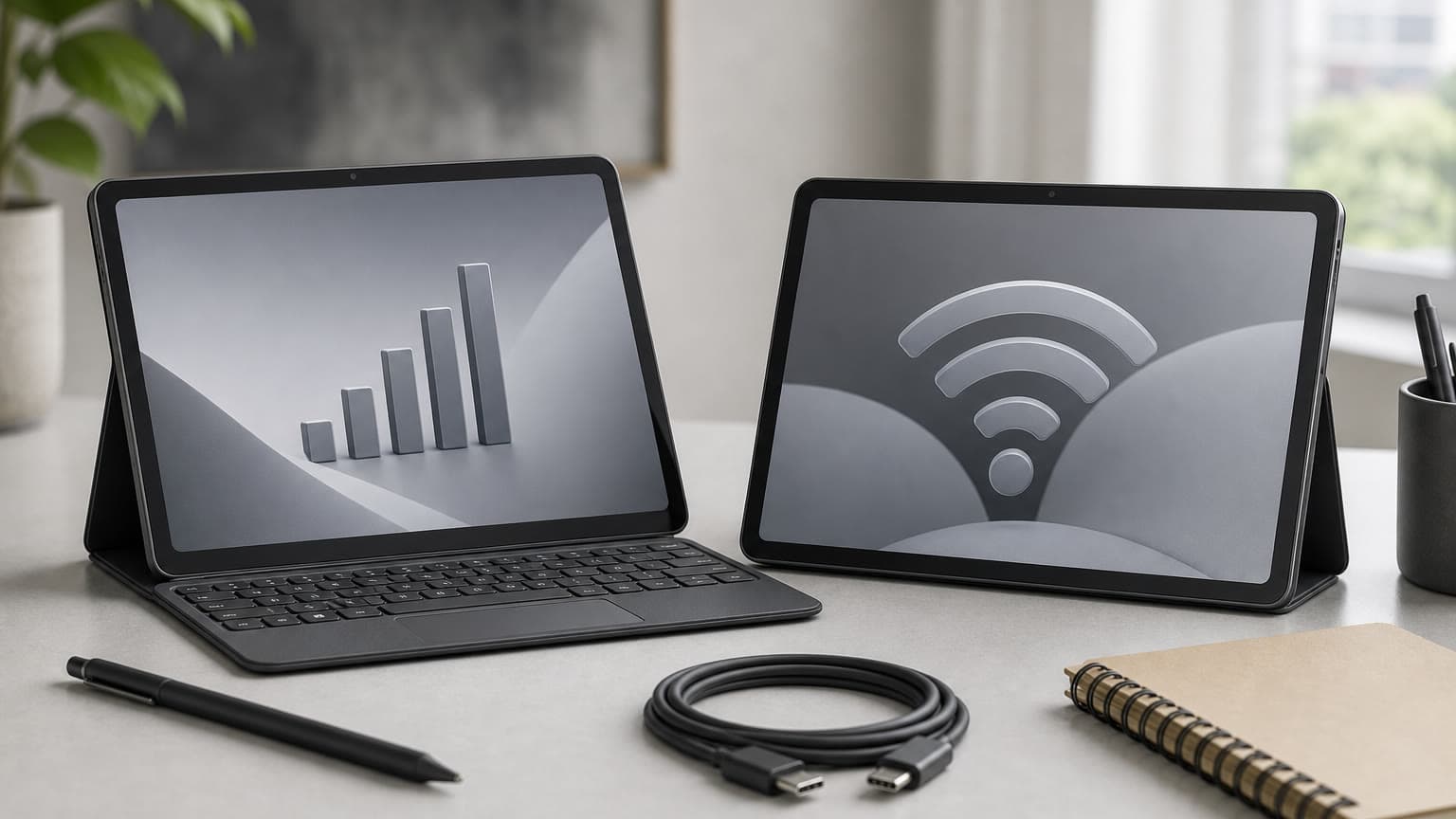
The Wi-Fi model has the lower Ogabassey price, while the 5G model charges extra for mobile connectivity.
Price and value in Nigeria
The Wi-Fi Redmi Pad 2 Pro is the value pick because it keeps the same display, chipset, battery and charging spec as the 5G version at a lower starting price. At ₦352,837.21, it is easier to recommend for students, shared family use, streaming, reading, document editing and online classes where a phone hotspot or router is already available.
The Redmi Pad 2 Pro 5G is not simply a more expensive color option. At ₦455,813.95, the higher price buys 5G support, eSIM support where available by region, and a 13MP rear camera instead of the Wi-Fi model's 8MP rear camera. Ogabassey's first-party product signal also shows one paid-order history entry for the 5G model, with a last sold price of ₦563,000 on 2026-06-12. That does not prove a trend, but it does show real Ogabassey order activity for the 5G variant. The Wi-Fi model has no transaction-history signal in the supplied data, so it should not be described as rising, falling or discounted.
Both listings are marked in stock in the supplied catalog signal, but stock quantity is unmanaged. In plain buying terms, do not treat a zero quantity field as a hard out-of-stock warning here; use the live product pages to confirm the exact selected variant, price and availability before payment. Start with the Redmi Pad 2 Pro product page if you want the lower-cost model, or the Redmi Pad 2 Pro 5G product page if mobile connectivity is the reason you are upgrading.
Catalog-verified comparison table
Spec
Redmi Pad 2 Pro
Redmi Pad 2 Pro 5G
Technology
Wi-Fi 6
5G + eSIM, Wi-Fi 6
5G support
No
Yes
SIM
Not listed
Dual 5G SIM + eSIM (region dependent)
Dimensions
279.80 x 181.65 x 7.5 mm
279.80 x 181.65 x 7.5 mm
Weight
610g
600g
Display type
LCD
LCD
Display size
12.1 inches
12.1 inches
Resolution
2560 x 1600
2560 x 1600
Refresh rate
120Hz
120Hz
Peak brightness
600 nits
600 nits
OS
Xiaomi HyperOS 2
Xiaomi HyperOS 2
Chipset
Snapdragon 7s Gen 4
Snapdragon 7s Gen 4
GPU
Adreno 810 @ 1150MHz
Adreno 810 @ 1150MHz
Card slot
microSD, up to 2TB
microSD, up to 2TB
Main camera
8MP
13MP
Selfie camera
8MP
8MP
Bluetooth
5.4
5.4
NFC
No
No
Battery capacity
12000mAh
12000mAh
Wired charging
33W
33W
Colors
Graphite Gray, Silver, Lavender Purple
Graphite Gray, Silver
Performance and daily use
For apps, multitasking, browser tabs, study notes, video streaming and light creative work, the two tablets should feel very close because the catalog lists the same Snapdragon 7s Gen 4 chipset, same CPU cluster and same Adreno 810 GPU. Ogabassey should avoid claiming benchmark wins here because this draft is based on catalog and official-source evidence, not lab testing. The useful buyer takeaway is simpler: do not pay for the 5G model expecting a faster processor, because the supplied spec matrix does not show a chipset difference.
The shared microSD support up to 2TB is important for Nigerian buyers comparing tablets against entry laptops. If you store downloaded lectures, PDFs, offline Netflix content, YouTube project files or large WhatsApp media folders, expandable storage gives both models a longer useful life. RAM and storage options are listed as 6GB/8GB and 128GB/256GB in the catalog metadata, but the exact selected variant should be checked on the product page before checkout because the price can vary by configuration.
For accessory-led productivity, both tablets are in the same position from the data supplied. The first-party site search signal includes interest in "redmi stylus pen", so stylus and keyboard questions matter, but this candidate data does not provide a specific compatible stylus SKU or keyboard SKU to link. The safe advice is to confirm accessory compatibility on the exact tablet variant before buying. If your main plan is handwritten notes, sketching, annotation or laptop-style typing, ask Ogabassey to confirm the supported stylus/keyboard bundle rather than assuming every Redmi tablet accessory fits every Redmi Pad generation.
Battery, display and build
The display story is effectively tied. Both models use a 12.1-inch LCD with 2560 x 1600 resolution, 249 ppi pixel density, 120Hz refresh rate and 600 nits peak brightness. That combination is well suited to reading, streaming, split-screen study, lecture slides and light design review. Because both have the same listed display specs, the decision should come down to connectivity, camera and price, not screen quality.
Battery is also tied on paper: 12000mAh capacity, 33W wired charging and reverse charging on both models. That is useful in a Nigerian context where a tablet may need to handle long school days, commute time, evening entertainment or power interruptions. Still, this is not a battery-life test. Real endurance will depend on brightness, refresh rate, app mix, speaker use and whether the 5G model is actively using mobile data in weak signal areas.
The body dimensions are identical at 279.80 x 181.65 x 7.5 mm. The 5G model is listed at 600g, while the Wi-Fi model is 610g. That 10g difference is too small to drive the purchase for most people, but it is one of the few physical differences in the matrix. Color choice may matter more: the Wi-Fi model lists Graphite Gray, Silver and Lavender Purple, while the 5G model lists Graphite Gray and Silver.
Students and creators should confirm keyboard and stylus compatibility for the exact tablet variant before checkout.
Decision scorecard
Buyer priority
Better choice
Why it matters
Lowest current Ogabassey price
Redmi Pad 2 Pro
It is listed at ₦352,837.21 versus ₦455,813.95 for the 5G model.
Mobile internet away from Wi-Fi
Redmi Pad 2 Pro 5G
It adds 5G plus eSIM support where region and carrier support apply.
Display for streaming and study
Tie
Both list a 12.1-inch 2560 x 1600 LCD with 120Hz refresh rate.
Battery capacity
Tie
Both list a 12000mAh battery and 33W wired charging.
Rear camera
Redmi Pad 2 Pro 5G
The 5G model lists a 13MP rear camera; the Wi-Fi model lists 8MP.
Storage flexibility
Tie
Both support microSD cards up to 2TB.
Accessory buying confidence
Tie, verify first
The supplied catalog does not name exact compatible stylus or keyboard SKUs.
Color choice
Redmi Pad 2 Pro
It lists Graphite Gray, Silver and Lavender Purple, while the 5G model lists two colors.
Who should buy each option?
Buy Redmi Pad 2 Pro if Wi-Fi is enough
Choose the Wi-Fi model if the tablet will mostly live at home, in a classroom, in an office or anywhere with dependable Wi-Fi. It gives you the same screen, chipset, battery size, charging speed, stereo speakers and storage expansion for less money. This is the sensible pick for students who already use a phone hotspot, parents buying a shared entertainment tablet, readers, note-takers, and buyers who want the largest useful display for the lowest current Ogabassey price in this pair.
Buy Redmi Pad 2 Pro 5G if the tablet must work independently
Choose the 5G model if your tablet needs its own internet connection. That applies to field sales, dispatch coordination, outdoor content work, travel, pop-up shops, events, school environments with unreliable Wi-Fi, or anyone who does not want to keep draining a phone battery through hotspot use. The 13MP rear camera is also a small advantage for scanning documents, capturing whiteboards or quick work photos, although neither model should be bought mainly as a camera device.
Alternatives to consider
If the price gap is uncomfortable, browse the wider Ogabassey tablets category before committing. A smaller or older tablet may be enough if your priority is casual streaming, reading, kids' learning apps or a backup device. But if you specifically want this Redmi Pad 2 Pro family, the meaningful alternative is not a different processor or screen inside the family; it is Wi-Fi-only value versus mobile-data independence.
Buyers searching for Redmi Pad 2 or Redmi Pad SE pricing in Nigeria should also be careful with naming. Redmi's tablet lineup has several similar names across sizes and generations, and accessories may not be cross-compatible. Use the exact Ogabassey product slug and model name before comparing prices, cases, keyboards or stylus options.
Verdict
The Redmi Pad 2 Pro is the better-value buy for most Nigerians because it keeps the same 12.1-inch 120Hz display, Snapdragon 7s Gen 4 chipset, 12000mAh battery and 33W charging at a lower Ogabassey price. The Redmi Pad 2 Pro 5G is worth the extra ₦102,976.74 only if 5G/eSIM connectivity or the 13MP rear camera matters to your daily use. The two decisive rows are Technology, where Wi-Fi 6 becomes 5G + eSIM plus Wi-Fi 6, and Main Camera, where 8MP becomes 13MP. If those differences do not solve a real problem for you, buy the Wi-Fi model and put the savings toward accessories or storage.
FAQ
What is the Redmi Pad 2 Pro price in Nigeria on Ogabassey?
The supplied Ogabassey catalog lists the Redmi Pad 2 Pro at ₦352,837.21. Confirm the live price, storage variant and availability on the product page before checkout.
What is the Redmi Pad 2 Pro 5G price in Nigeria on Ogabassey?
The supplied Ogabassey catalog lists the Redmi Pad 2 Pro 5G at ₦455,813.95. The 5G model costs more because it adds 5G/eSIM connectivity and a 13MP rear camera.
Which one should I buy for school or online classes?
Buy the Redmi Pad 2 Pro if you have reliable Wi-Fi or can use a phone hotspot. Buy the 5G model if your school, hostel or commute makes independent mobile data more important.
Do both Redmi Pad 2 Pro models support a stylus or keyboard?
The supplied data shows buyer interest in a Redmi stylus pen, but it does not name exact compatible accessory SKUs. Confirm stylus and keyboard compatibility for the exact variant before buying.