Smartphones
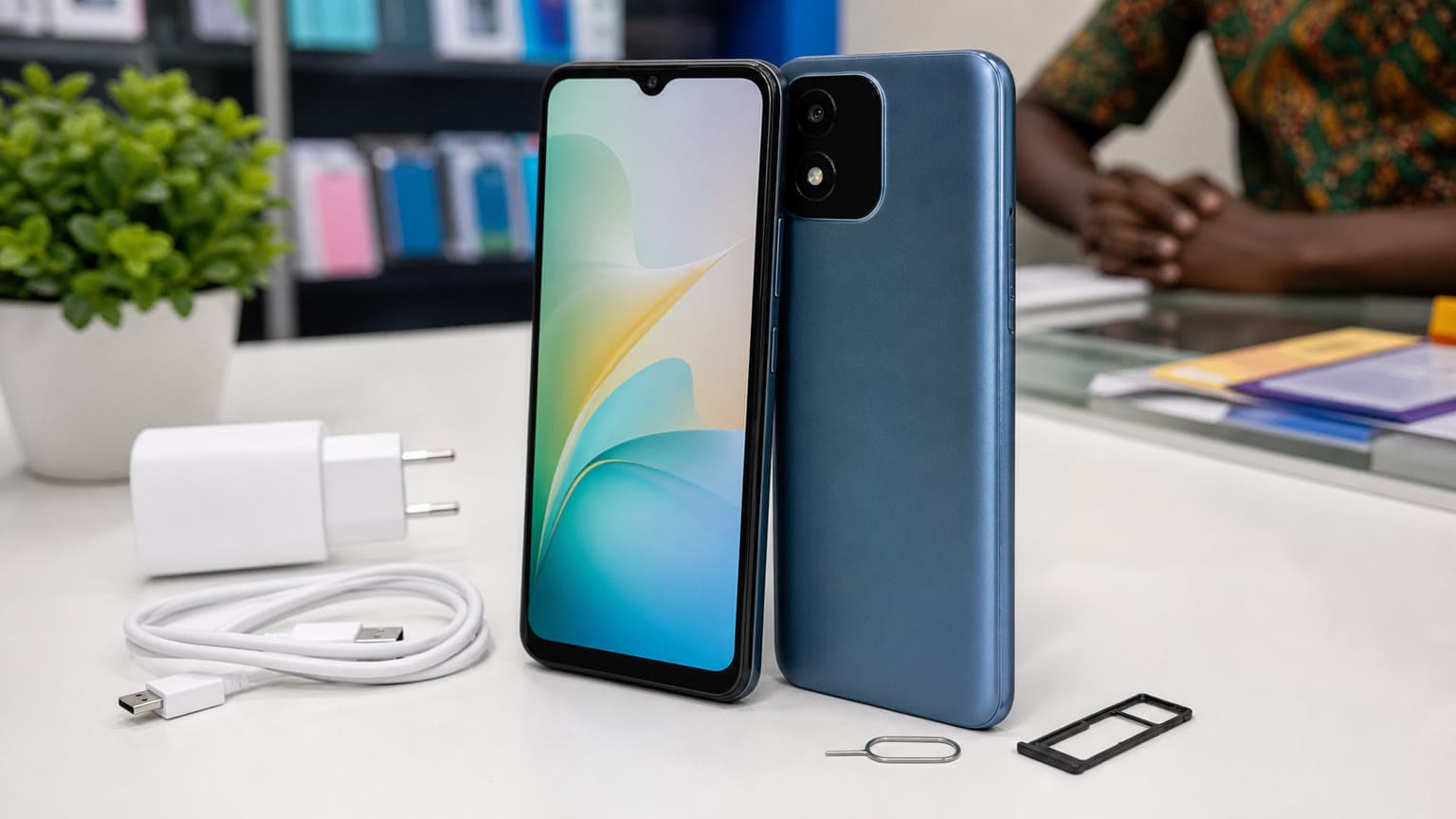
The Redmi 17 is a battery-first Xiaomi phone for buyers who want a large screen, long runtime, expandable storage, and a new-device purchase path without moving into premium pricing. In the Ogabassey catalog snapshot reviewed for this update, the Redmi 17 is listed at ₦198,511.63 and marked available, but that should be treated as a dated editorial snapshot rather than a permanent price or a warehouse stock guarantee.
Xiaomi lists a 3.5mm headphone jack and FM radio support, with NFC availability depending on market. The main compromise is 4G connectivity rather than 5G.
The Redmi 17 makes the most sense for students, family buyers, riders, field workers, small-business users, and heavy WhatsApp or hotspot users who care more about battery comfort than benchmark scores. Its 7,500mAh battery is the headline, and the 6.9-inch display gives you plenty of space for reading, videos, maps, banking apps, social media, school notes, and everyday work chats.
It is less suitable if your must-have list starts with 5G, optical image stabilization, stereo speakers, flagship gaming, premium low-light video, or guaranteed NFC payments. At this price band, every phone is a bundle of compromises. The Redmi 17’s bundle is easy to understand: spend the money on battery, screen size, practical ports, and mainstream Xiaomi familiarity; accept limits in network future-proofing, display sharpness, camera stabilization, and heavy multitasking.

Xiaomi’s official specification page for the Redmi 17 lists a 6.9-inch display with 1600 x 720 resolution and up to 120Hz refresh rate. That gives the phone a big, smooth-feeling canvas for scrolling and media, but it is not a high-density Full HD or AMOLED-style panel. If you read small text for hours or compare screens closely, the resolution is worth checking before you buy.
The chipset is listed as MediaTek Helio G91-Ultra, which places the Redmi 17 in practical 4G territory. Expect it to handle calls, WhatsApp, Chrome, YouTube, TikTok, Facebook, banking apps, email, Google Maps, notes, music, and light games. Do not buy it expecting a performance jump like a 5G gaming phone or a higher Redmi Note model with a stronger processor.
The Ogabassey product snapshot points to a 4GB RAM and 128GB storage configuration. Xiaomi’s regional listings may show other memory options, so the safest buyer habit is to confirm the exact RAM and storage on the live product page or invoice before payment. The 128GB storage level is useful for offline videos, school documents, voice notes, WhatsApp media, music, and photos, and the official specs include microSD support up to 2TB. The 4GB RAM figure is the tighter part of the configuration: fine for moderate use, but not ideal for people who keep many apps and browser tabs alive at once.
| Area | Current evidence | Buyer meaning |
|---|---|---|
| Ogabassey price snapshot | ₦198,511.63 as checked on 21 September 2026 | Use it as a dated reference, then check the live product page before checkout. |
| Availability | Check the live offer and delivery timing | Confirm live availability, delivery timing, and exact variant before payment. |
| Condition | New in the catalog snapshot | Ask for receipt, warranty route, return terms, and sealed-box status. |
| Display | 6.9-inch, 1600 x 720, up to 120Hz | Large and smooth, but not the sharpest screen class. |
| Network | 4G LTE, no 5G listed | Good for current 4G value; less future-proof than a 5G model. |
| Battery and charging | 7,500mAh typical battery, 45W wired charging | The main reason to shortlist the phone. |
| Camera | 50MP main camera, 8MP front camera, no OIS listed | Best expectations are daylight photos, documents, and casual social use. |
| Audio and ports | 3.5mm headphone jack listed; single speaker listed | Good for wired earphones, but stereo sound is not the focus. |
| Radio | FM radio listed in Xiaomi’s regional specs | Useful for buyers who still rely on radio without streaming data. |
| NFC | Market dependent | Do not assume Nigerian units have NFC; verify the exact unit if payments matter. |
| Durability | IP64 dust and splash resistance, Corning Gorilla Glass 7i listed | Helpful protection, but still use a case and avoid water exposure. |
The 7,500mAh battery is the Redmi 17’s strongest advantage. Many affordable phones still sit closer to 5,000mAh, so Xiaomi is clearly aiming this model at people who hate charging anxiety. For Nigerian buyers, that can be more meaningful than a marginally faster chip, especially if your day includes long commutes, weak power supply, hotspot sharing, or field work.
Xiaomi lists 45W charging, which matters because a very large battery can become annoying if it refills slowly. Box contents and charger availability can vary by region and seller, so confirm whether the correct charging adapter is included or whether you need to buy one separately. A 45W-capable phone is most useful when the charger situation is clear upfront.
Battery life will still depend on signal strength, dual-SIM use, screen brightness, hotspot time, games, camera use, and background apps. It would be misleading to promise a fixed number of hours without local testing. What the specification does support is a clear buyer expectation: the Redmi 17 is built to last longer between charges than many ordinary budget phones, and that is its biggest reason to exist.
The 50MP main camera should be treated as an everyday camera, not a creator-grade system. It should be useful for receipts, school notes, daylight portraits, product listings, documents, casual food photos, and social media posts in good light. The missing optical image stabilization is the key limitation. OIS helps steady photos and video, especially indoors and at night; without it, hand movement and poor light become more obvious.
Do not judge the Redmi 17 by megapixels alone. A 50MP camera on a battery phone can still lose to a lower-resolution camera with better stabilization, stronger processing, or a more capable sensor. If you regularly record TikTok videos, indoor events, church services, children, nightlife, or business content, compare the Redmi 17 against phones with OIS and stronger camera reviews before deciding.
The 8MP front camera is acceptable for video calls, casual selfies, online classes, and routine social use. It is not the feature that should convince a content creator. If front-camera clarity is central to your work, the Redmi 17’s battery advantage may not outweigh its camera limits.

The Helio G91-Ultra should be enough for everyday Android use, but the 4GB RAM catalog configuration deserves careful attention. Four gigabytes can work for moderate users who keep expectations realistic, close heavy apps, and avoid filling the phone with background processes. It can feel tight for business users who jump between WhatsApp Business, Instagram, Chrome tabs, banking apps, delivery apps, spreadsheets, and photo editing.
If the Redmi 17 is for a parent, student, or light user, the performance balance is sensible. If it is for a multitasking seller, creator, gamer, or someone who keeps phones for three to four years, compare prices on higher-RAM options before buying. More RAM will not fix every problem, but it can make a phone age more comfortably as apps grow heavier.
The 6.9-inch display is a strong fit for buyers who want a phone that can double as a small entertainment and reading device. It is useful for maps, YouTube, long chats, ebooks, notes, football scores, trading apps, and spreadsheets. The 120Hz refresh rate can make scrolling feel smoother where supported.
The compromise is resolution. At 1600 x 720, this is not the panel to choose if your priority is crisp text, high-resolution streaming, or photo editing detail. For buyers who mainly want a big display that is easy to use and friendly to battery life, the trade-off may be acceptable. For buyers who value sharpness more than battery size, compare other Ogabassey smartphones before committing.
Durability is helped by IP64 dust and splash resistance plus Corning Gorilla Glass 7i in Xiaomi’s specification. That does not make the phone waterproof. Use a case, add a screen protector if you are rough on phones, and avoid treating splash resistance as permission to expose it to rain, sinks, pools, or repair-shop experiments.
The Redmi 17 is a 4G phone. That is acceptable if your mobile plan, location, and budget are still built around LTE. It may even help battery life in areas where 5G coverage is weak or inconsistent. The trade-off is future-proofing. If you plan to keep one phone for several years in Lagos, Abuja, Port Harcourt, Accra, Nairobi, or another city where 5G coverage may improve, a 5G phone may age better.
Xiaomi lists a 3.5mm headphone jack and FM radio. These are useful for wired listening and radio without relying on streaming data.
NFC needs caution. Xiaomi lists NFC as market dependent, so buyers should not assume every Redmi 17 unit supports it. If tap-to-pay, access cards, or NFC pairing are important to you, ask the seller to verify the exact variant before payment. This is especially important with imported regional units, where small feature differences can appear even when the product name looks identical.
Software support is one of the biggest 2026 buyer checks for affordable Android phones. Xiaomi’s Redmi line usually competes strongly on hardware value, but official update policies can vary by model and region. Before checkout, buyers who plan to keep the phone for several years should confirm the Android version, HyperOS version, and available security updates on the exact retail unit.
Ogabassey’s catalog marks the Redmi 17 as available, but availability should always be verified on the live product page before payment. Confirm the exact RAM and storage, color, box contents, charger arrangement, warranty route, delivery timeline, return window, and whether the unit is sealed. These checks are not small details; they are part of the real value of a phone purchase.
The Redmi 17 should be compared against other battery-led budget phones, higher-RAM Redmi models, affordable Samsung Galaxy A-series options, Tecno and Infinix devices with aggressive local feature mixes, and used or open-box phones where warranty risk is acceptable. The right alternative depends on what you refuse to compromise.
Choose the Redmi 17 if your priorities are battery size, a big display, wired earphone support, FM radio, expandable storage, and new-condition value around the current Ogabassey snapshot price. Consider stepping up if you need 5G, more RAM, a sharper Full HD display, better video stability, stereo speakers, or stronger long-term software assurance. Consider stepping sideways if another phone gives you clearer warranty terms or a better local bundle at a similar price.
Ogabassey’s Itel Power 80 review is useful if your main question is how much battery value you can get below or around this segment. Buyers looking at cheaper Android options can also compare the Itel A100C value guide, while shoppers who prefer Samsung can use the Samsung Galaxy A07 battery and camera check for another budget-phone reference point.
For readers following Xiaomi’s broader direction, Ogabassey’s coverage of the Xiaomi 17T Pro launch shows how a premium Xiaomi camera and performance story differs from the Redmi 17. That context is useful because it keeps expectations fair. The Redmi 17 is not trying to be a Leica-style camera phone; it is a large-battery value phone.
The Redmi 17 is a strong shortlist phone if your main pain point is battery life and your budget is close to the current Ogabassey snapshot of ₦198,511.63. Its 7,500mAh battery, 45W charging, 6.9-inch 120Hz display, 128GB storage configuration, microSD support, headphone jack, FM radio, IP64 rating, and mainstream Xiaomi ecosystem make it practical for everyday Nigerian use.
The cautions are just as important. It is 4G-only, the catalog configuration has 4GB RAM, the display resolution is modest for its size, the camera lacks OIS, speaker output is not positioned as stereo, NFC depends on market variant, and software support should be confirmed on the exact unit. If those limits do not affect your daily use, the Redmi 17 is a sensible battery-led buy. If they do, use the live Redmi 17 product page as a starting point, then compare against other phones before checkout.
The Redmi 17 is listed at ₦198,511.63 in the Ogabassey price snapshot checked for this article, updated on 2026-09-21. Treat that as an editorial price snapshot and check the live product page for the current offer.
No. The Redmi 17 is a 4G LTE phone. That is fine for buyers focused on battery and price value, but shoppers who want stronger future-proofing should compare 5G alternatives.
Yes, Xiaomi’s official regional specifications list a 3.5mm headphone jack and FM radio support. Confirm the exact retail unit if those features are essential to you.
NFC is market dependent. Do not assume every Redmi 17 unit has it, especially if you are buying an imported regional variant. Ask the seller to confirm the exact model before payment.
It should be good enough for daylight photos, documents, casual portraits, and routine social posts. It is not the best choice if you care heavily about low-light video or moving subjects because OIS is not listed.
Pay extra for 5G if you plan to keep the phone for several years and your network, location, and data plan can benefit from it. If your budget and usage are still 4G-focused, the Redmi 17’s battery value may matter more.
Choose by need. Redmi 17 is strongest for battery capacity, screen size, wired audio, and value. Samsung may appeal for brand preference and software confidence, Tecno and Infinix often compete hard on local features, and iPhone at this budget usually means accepting older or used-device compromises.