Bassey John is a Performance Marketing Specialist at Ogabassey with cross-industry experience spanning e-commerce, gaming, and real estate. He focuses on paid acquisition, conversion-rate optimisation, and data-driven growth strategy, turning campaign performance into measurable revenue. At Ogabassey he writes about consumer technology, product buying guides, and the Nigerian gadget market to help shoppers make confident, informed decisions.
Continue shopping smartphones
Compare Apple verified prices, condition grading, and key specs in smartphones.
Choose the iPhone 14 Plus for its bigger screen and lower starting price; choose the iPhone 15 Pro for its smoother display, more versatile cameras and smaller body. Ogabassey’s supplied snapshot lists them from ₦570,000 and ₦795,200 respectively, making the Pro’s ₦225,200 premium the key buying decision.
Decision summary: bigger screen or Pro features?
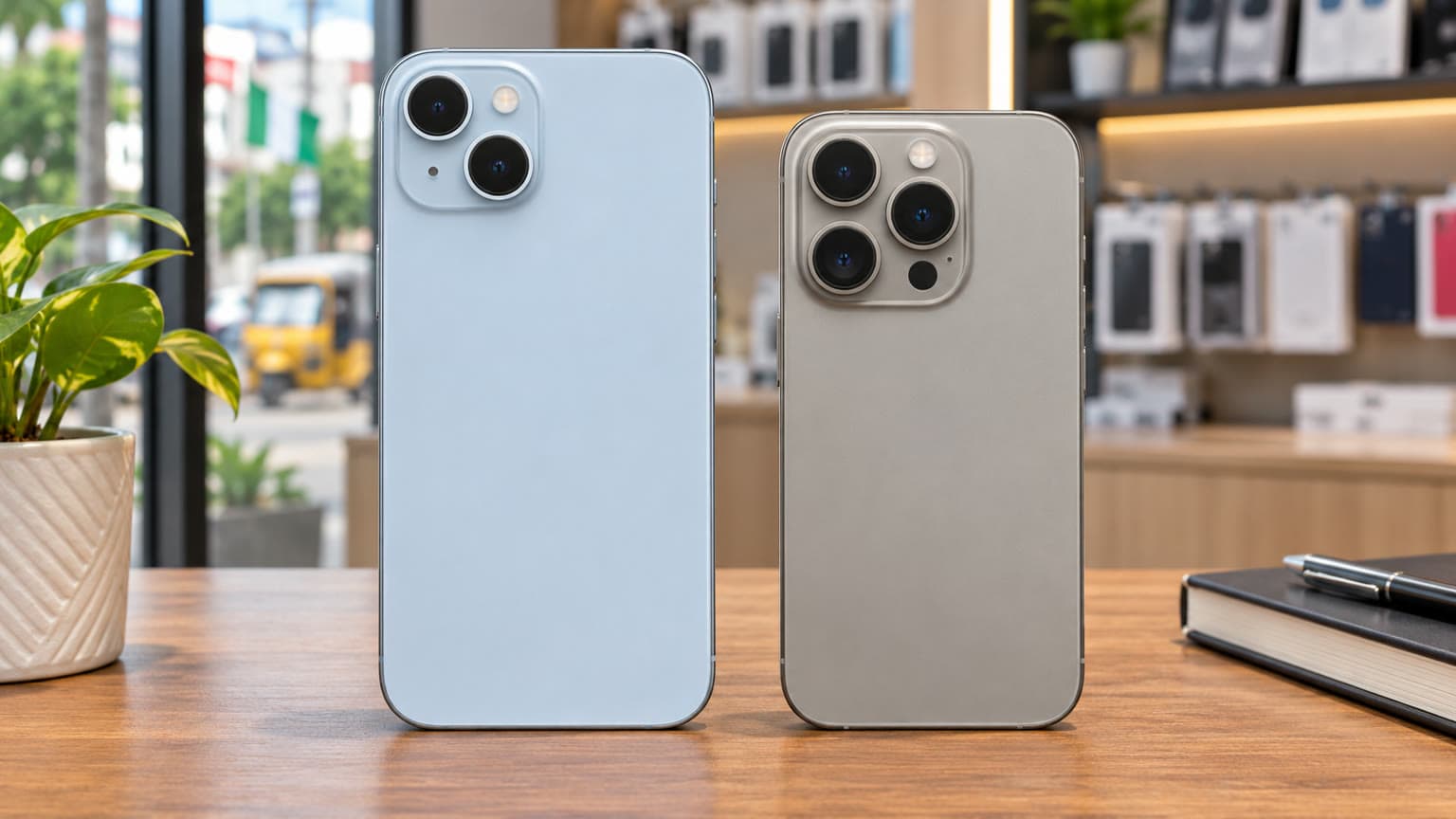
The iPhone 14 Plus and iPhone 15 Pro suit different priorities. The Plus gives you a 6.7-inch display for reading, watching videos and viewing documents. The Pro reduces screen size to 6.1 inches while adding a refresh rate of up to 120Hz, an A17 Pro processor and a more flexible camera system. Paying more therefore buys capability and portability, rather than a larger phone.
Our editorial recommendation is to start with the 14 Plus if everyday communication, entertainment and purchase cost dominate your decision. Move to the 15 Pro when you can identify a feature you will regularly use: telephoto framing, smoother scrolling, USB-C connectivity or a narrower body. These are catalog-based buyer judgements, not findings from hands-on testing.
Both supplied product records identify the default condition as used and list Open Box and used choices. Neither starting price should be interpreted as a brand-new offer, or as a guaranteed quote for the same storage, colour and condition.
The 14 Plus prioritises a 6.7-inch screen; the 15 Pro combines a smaller display with adaptive ProMotion.
iPhone 14 Plus vs iPhone 15 Pro: specification comparison
The following table uses selected rows from Ogabassey’s supplied comparison matrix. Storage describes the normalized configuration; selectable variants differ. The brightness figures have different contexts, explained below, and the Pro’s 2x framing option does not represent a fourth rear camera.
Selected catalog specifications for iPhone 14 Plus and iPhone 15 Pro
Attribute
iPhone 14 Plus
iPhone 15 Pro
5G support
Yes
Yes
Dimensions
160.8 × 78.1 × 7.80 mm
146.6 × 70.6 × 8.25 mm
Weight
203g
187g
Build
Aluminium, Ceramic Shield front, glass back
Titanium design, Ceramic Shield front, textured matte glass back
SIM configuration
Physical SIM and eSIM variants listed; regional differences apply
Physical SIM tray on non-US models; eSIM support varies by region
4K Dolby Vision up to 60 fps; ProRes, Action mode and spatial video
Optical image stabilisation
Yes
Yes
Front camera
12MP
12MP
Speakers
Stereo
Stereo
3.5mm headphone socket
No
No
Wi-Fi
Wi-Fi 6
Wi-Fi 6E
Bluetooth
5.3
5.3
RAM figures are catalog values whose supplied provenance identifies secondary research; Apple does not publish these RAM capacities. The table is a selection of relevant differences and shared features, rather than a performance score.
Price in Nigeria: what does the ₦225,200 premium buy?
For this draft dated 10 November 2026, the supplied catalog snapshot lists the iPhone 14 Plus from ₦570,000, with variants reaching ₦760,000. Its product record was last updated on 3 October 2026 at 05:43:13 UTC. The iPhone 15 Pro starts at ₦795,200, with variants reaching ₦1,630,000; its record was updated on 9 November 2026 at 11:32:45 UTC.
These are dated editorial snapshots, not fresh checkout quotes. Neither record supplies a last price-sync timestamp. Use the linked live product cards for the current offer and confirm the selected variant before payment. The ₦225,200 difference compares the two minimum listed prices; it is not a verified like-for-like storage and condition premium.
Both records are marked in stock under unmanaged inventory. Their numeric stock counts therefore do not establish that either model is sold out, but the catalog status also does not guarantee that your preferred colour and storage combination is ready for dispatch. Ask for confirmation of the exact device and delivery timing.
For a buyer choosing between the minimum listed offers, the practical question is whether Pro features justify spending roughly 40% more. If the purchase stretches your budget, the larger display and lower entry price make the 14 Plus compelling. If you earn from photography or video, the Pro’s framing flexibility may be more valuable than the Plus’s extra screen area.
Performance and daily use: where will you notice the difference?
The catalog lists an A15 Bionic with a five-core GPU in the 14 Plus and an A17 Pro with a six-core GPU in the 15 Pro. Those specifications establish different hardware generations; they do not tell us how much faster a particular app will run on these used units. No benchmark or gaming temperature results accompany the assignment.
For calls, WhatsApp, email and ordinary browsing, choose around the whole experience rather than processor names alone. The Pro’s adaptive display can make supported scrolling and animation look smoother. The Plus gives documents and videos more physical space. A buyer who mostly reads PDFs may reasonably prefer the cheaper phone, while someone sensitive to display motion may favour the Pro.
Storage also deserves attention. The snapshot lists selectable 128GB and 256GB choices for the 14 Plus, and 128GB, 256GB, 512GB and 1TB choices for the 15 Pro. Neither accepts a memory card. Compare the capacity you actually need: a higher-storage Plus may be a better fit than a minimum-storage Pro if you keep many videos offline.
Battery, display and build: the larger phone has a purpose
Battery verdict: favour condition before the model badge
Apple rates the 14 Plus for up to 26 hours of local video playback and the 15 Pro for up to 23 hours. Those controlled manufacturer ratings support a battery-focused case for the Plus, but they are not a prediction of mixed-use endurance on the individual used phones being offered.
Ask for the actual Battery Health reading and any service recommendation. A worn battery can change the buying calculation enough to outweigh a modest specification advantage. Request the cycle count where available, but do not assume every model exposes the same information in the same place. Include any quoted battery replacement cost in your total budget.
Display verdict: size and smoothness are separate benefits
The 14 Plus offers a larger viewing area, while their near-identical listed pixel densities mean the Pro’s advantage is not simply sharper text. The Pro instead combines a smaller panel with adaptive refresh rates up to 120Hz. Its narrower 70.6mm body, compared with 78.1mm for the Plus, is also worth considering if you often operate your phone with one hand.
The brightness numbers need care: Apple specifies the Plus’s 1200-nit peak for HDR, while the Pro’s 2000-nit peak is an outdoor figure. They are not equivalent measurements of everyday brightness. Avoid interpreting the table as proof that the Pro is always a fixed percentage brighter.
The Pro weighs 187g against the Plus’s 203g, a 16g reduction. Titanium design does not establish cheaper repairs or immunity to damage. For either used phone, inspect the frame, glass and camera area rather than treating its original IP68 rating as a guarantee of present water resistance.
Charging verdict: choose the connector that fits your accessories
The product detail groups list Lightning for the 14 Plus and USB-C for the 15 Pro, with 15W wireless charging entries for both. USB-C may simplify your setup if your other devices already use it. Existing Lightning accessories may make the Plus more convenient initially. Confirm the included cable and power adapter; accessory contents are not guaranteed by this snapshot.
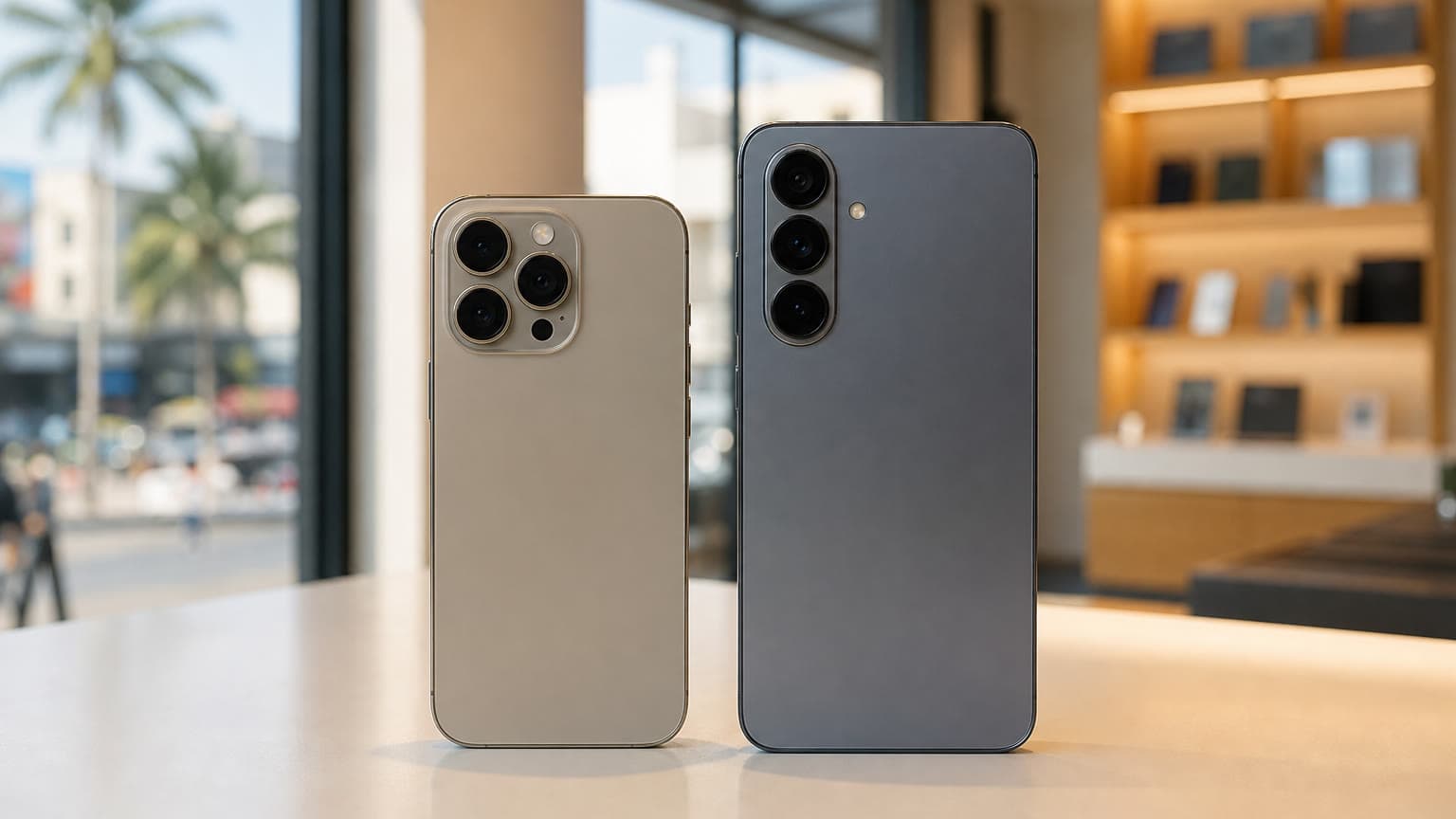
The 15 Pro adds a dedicated 3x telephoto camera; its 2x option uses the main sensor.
Camera verdict: the strongest reason to buy the 15 Pro
The 14 Plus combines a 12MP main camera and 12MP ultra-wide camera. The Pro’s catalog listing adds a 48MP main camera and a dedicated 3x telephoto. Apple clarifies that its 2x option uses the main sensor, so the listing should not be read as four separate rear cameras.
That distinction matters when photographing products, portraits or subjects you cannot approach. The Pro offers more framing choices without relying only on the Plus’s main and ultra-wide views. Its advantage is versatility; megapixel count alone cannot establish that every photograph will look better.
Both listings include 4K Dolby Vision recording up to 60 fps. The Pro also offers ProRes workflows, but those features warrant extra spending only if your editing process uses them. For casual family clips and social uploads, the shared recording capability gives the Plus a credible value argument. We have no supplied comparison footage establishing low-light, stabilisation or microphone winners.
SIM compatibility, software support and ownership costs
Both phones support 5G, so the Pro premium is not necessary merely to obtain that capability. For Lagos, Abuja or elsewhere, check coverage at the places you use the phone and confirm your tariff and SIM provisioning. A city name alone does not establish the connection you will receive.
Regional hardware is more consequential than the generation number. The catalog describes physical-SIM and eSIM variations, and Apple notes that US-purchased 15 Pro models lack a physical SIM tray. Ask for the regional model number and confirm the exact arrangement. If using MTN, Airtel or Glo, establish whether your intended line can be activated on that device before choosing an eSIM-only import.
For software longevity, this evidence does not establish a guaranteed final iOS version or support end date for either phone. The newer processor is a reason to investigate the Pro’s feature compatibility, not permission to promise extra years of updates. Verify any essential app or software feature on the installed system before purchase.
Apple’s pre-owned buying guidance recommends checking Battery Health, network lock and Parts and Service History where available. Confirm that Activation Lock has been removed and the device can complete setup. Match the serial or IMEI on the device to the transaction paperwork, while remembering that an identifier alone does not prove untouched hardware.
Warranty duration, return window and repair prices are not listed in the supplied records. Get those terms in writing, including how faults discovered after delivery are handled. For local ownership planning, ask Ogabassey’s phone repair team about assessment and a current quote for any identified fault. This draft cannot rank either phone as cheaper to repair without comparable service estimates.
Who should buy each option?
Decision guide based on catalog facts and editorial judgement
Your priority
Better starting point
Reason or condition
Lower purchase cost
iPhone 14 Plus
Lower minimum price in the supplied snapshot
Large display for reading and entertainment
iPhone 14 Plus
6.7-inch display versus 6.1 inches
Battery-focused buying
iPhone 14 Plus
Higher Apple local-video rating; verify individual battery condition
Smoother display motion
iPhone 15 Pro
Adaptive refresh rates up to 120Hz
Camera framing flexibility
iPhone 15 Pro
Dedicated 3x telephoto and sensor-enabled 2x option
Smaller and lighter body
iPhone 15 Pro
Narrower dimensions and 187g weight
USB-C accessories
iPhone 15 Pro
USB-C rather than Lightning
Repair cost and warranty confidence
Compare individual offers
No comparable repair prices or warranty terms supplied
Alternatives if neither trade-off suits you
If you want a larger display but are also considering the newer generation, read our iPhone 15 Plus vs 15 Pro comparison. It addresses a closely related size-versus-camera decision. Obtain a current offer before assuming that alternative sits between these two prices.
You can also browse the Apple iPhone range, including the iPhone 14 family and iPhone 15 family. Keep storage, battery condition and warranty terms consistent when comparing offers. This assignment does not provide enough matched evidence to declare a Samsung, Tecno, Infinix, Xiaomi or Pixel alternative the winner.
Verdict: buy the features you will use
Choose the iPhone 14 Plus for value and screen space; choose the iPhone 15 Pro for camera flexibility and a smoother, more compact experience. The matrix’s 6.7-inch versus 6.1-inch displays and 203g versus 187g weights explain the physical trade-off. Its 60Hz versus up-to-120Hz refresh rates explain another benefit of the Pro premium. At the supplied starting prices, our judgement favours the Plus for budget-conscious everyday use and the Pro for buyers who regularly need its camera and display features, subject to inspecting the exact unit.
FAQ
Which phone is best for my budget in Nigeria?
The supplied snapshot lists the iPhone 14 Plus from ₦570,000 and iPhone 15 Pro from ₦795,200. Choose the Plus if lower cost and a larger screen matter most. Consider the Pro for its smoother display, telephoto camera and smaller body. Check live product cards and match storage and condition before comparing final prices.
Which has better battery life, iPhone 14 Plus or iPhone 15 Pro?
Apple rates the iPhone 14 Plus for up to 26 hours of local video playback and the iPhone 15 Pro for up to 23 hours. These are manufacturer ratings, not measurements of the listed used units. Inspect Battery Health and service history before deciding.
Is the iPhone 15 Pro camera worth paying more for?
It can be if you regularly need its dedicated 3x telephoto and additional framing options. The 14 Plus still offers main and ultra-wide cameras and 4K Dolby Vision video. The Pro premium is easier to justify for deliberate photography and video workflows than for occasional snapshots.
Is 5G worth paying extra for in Lagos or Abuja?
Both models already support 5G, so you do not need the 15 Pro solely for that feature. Check coverage where you use the phone, carrier provisioning and the exact regional model’s SIM arrangement. Location within a city matters more than assuming city-wide performance.
Catalog-linked prices update automatically. Historical and other quoted prices remain as written. Open the product page to confirm the current price, selected variant and availability before buying.