Bassey John is a Performance Marketing Specialist at Ogabassey with cross-industry experience spanning e-commerce, gaming, and real estate. He focuses on paid acquisition, conversion-rate optimisation, and data-driven growth strategy, turning campaign performance into measurable revenue. At Ogabassey he writes about consumer technology, product buying guides, and the Nigerian gadget market to help shoppers make confident, informed decisions.
Apple’s new 14-inch MacBook Pro brings a 12-core M6 processor and Wi-Fi 7, with availability scheduled from November 6 following its October 27 announcement. Nigerian buyers comparing it with Ogabassey’s M5 and M4 listings should weigh the actual configuration and local quote: M6 catalog availability and Nigerian pricing remain unconfirmed.
What changed in the M6 MacBook Pro?
Apple has moved its entry-level 14-inch MacBook Pro to another Apple Silicon generation. The M6 has a 12-core CPU and 12-core GPU, compared with the base M5 model’s 10-core CPU and 10-core GPU. Wireless connectivity advances to Wi-Fi 7 and Bluetooth 6. Apple opened preorders on October 28 and named November 6 as the start of availability in its announced launch markets.
TechRadar’s October 27 coverage independently reports the launch and its $1,999 US starting price. That figure is an overseas reference, not a Nigerian retail quote. The announcement does not establish an Ogabassey delivery date, landed cost or local warranty arrangement.
Apple claims graphics performance up to 30% faster than M5 and improvements in selected AI workloads. These are manufacturer results, not Ogabassey measurements. For a buyer, the useful question is whether a specific application would benefit enough to justify the eventual difference in naira.
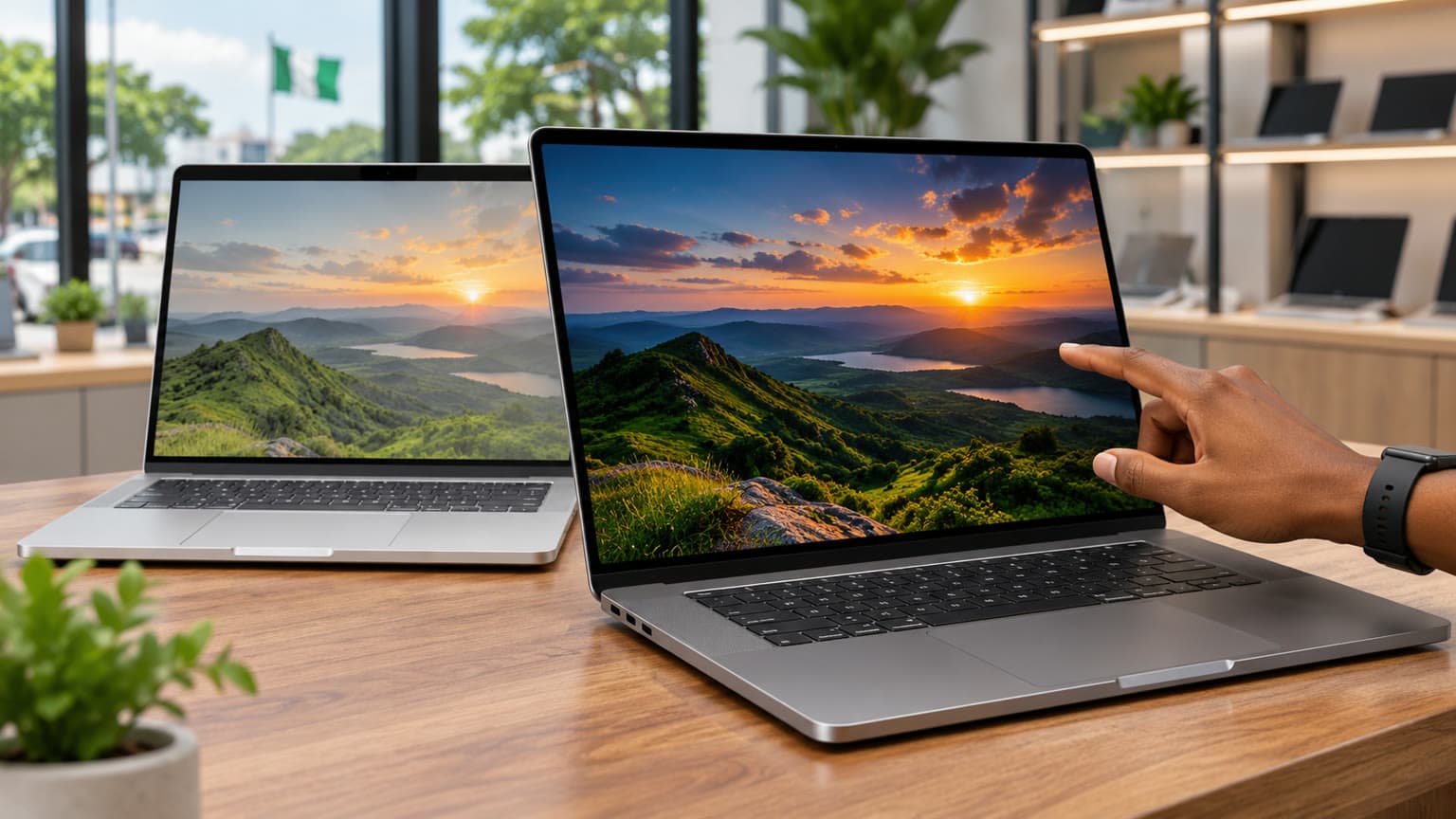
Illustration concept: compare the actual configurations before paying for a newer generation. Use accurate official references, blank screens and no text or logos.
M6 versus M5: compare the configuration before the generation
The new chip makes M6 worth considering for someone buying a first MacBook Pro or replacing a machine that struggles with daily work. It does not automatically make an existing M5 purchase a mistake. A generation label cannot tell you whether the laptop has enough memory for your projects or enough storage for your working files.
Apple’s technical specifications list M6 with 16GB, 24GB or 32GB unified memory and a 1TB, 2TB or 4TB SSD. There is also an important configuration distinction: the 16GB version has 153GB/s memory bandwidth, while the 24GB and 32GB versions have 170GB/s. Buyers should therefore avoid assuming that every advertised maximum applies to the cheapest configuration.
Our editorial recommendation is to write down the memory and storage of each actual offer before comparing prices. If your existing computer frequently runs short of memory, prioritise a configuration that resolves that problem. If storage is the constraint, price the capacity you need rather than comparing two laptops with different SSD sizes as though they were equivalent.
The same care applies to chip names. M6 is the base chip in this announcement; M5 Pro and M5 Max belong to different performance tiers. A newer number alone is insufficient evidence that M6 is the better choice for every demanding creative workload.
MacBook Pro price in Nigeria: the useful local comparison
The commissioning catalog supplied for this draft lists the 14-inch MacBook Pro M5 (2025) at ₦2,000,000 and the 13-inch MacBook Air M4 (2025) at ₦1,210,000. These are publication-time catalog figures reviewed for this November 6, 2026 draft; check the linked live product cards for the current offer and exact variant.
That ₦790,000 difference is a useful starting point for deciding whether your work needs a Pro at all. It is not a configuration-matched performance comparison. Students and remote workers should identify the applications, screen requirements and peripheral connections they need before spending more solely to obtain a newer chip.
The supplied first-party order evidence also records purchases of the M1 MacBook Air, M1 Pro MacBook Pro and M2 Pro MacBook Pro. This establishes that older Apple Silicon machines remain relevant within Ogabassey’s own customer activity; it does not establish their share of Nigeria’s laptop market or prove that they suit every buyer.
The peer listings use unmanaged stock. Their zero quantity fields do not independently establish that the products are unavailable. Confirm the exact configuration, condition and delivery estimate before paying. M6 has no supplied Ogabassey product record, so its catalog availability remains unconfirmed.
Display, battery and platform compatibility
Apple specifies a 14.2-inch Liquid Retina XDR display with adaptive refresh rates up to 120Hz. For M6, its battery estimates distinguish up to 24 hours of video streaming from up to 16 hours of wireless web use. Those are test estimates, not a promise of a full working day under rendering, video calls or other demanding tasks.
The connection options include three Thunderbolt 4 ports, HDMI, SDXC, MagSafe 3 and a headphone jack. Check these against the equipment you already own. A photographer’s card workflow, a presentation setup and a desk with several peripherals can create different requirements even when the buyers use the same software.
Apple introduces this model alongside macOS 27. Before changing platforms or replacing a work laptop, verify the current requirements of your essential applications, plug-ins and peripherals. For school, obtain the course software list. For an employer-managed machine, confirm that the organisation supports the proposed macOS configuration.
For gaming, start with the exact titles you intend to play. Do not treat a graphics improvement claim as proof that a particular game, launcher or accessory works on macOS. Compatibility should decide whether the platform belongs on your shortlist before processor comparisons decide which configuration to buy.
Illustration concept: assess the charger and peripherals your work requires. No readable text, logos, UI or hands-on testing claims.
Related Ogabassey alternatives: match the laptop to the job
Use the Apple MacBook catalog to establish the available range, then narrow the decision through the MacBook Pro family or MacBook Air family. Comparing these families can be more useful than treating M6 as the default answer for every budget.
For a larger-screen shortlist, the supplied catalog includes the 15-inch MacBook Air M4 (2025) and 15-inch MacBook Air M5 (2026). For buyers investigating more demanding work, it includes the 14-inch MacBook Pro M5 Pro (2026), 16-inch MacBook Pro M5 Pro (2026) and 16-inch MacBook Pro M5 Max (2026). The 14-inch MacBook Pro M4 Max (2024) is another listed option to assess by configuration and condition.
These are alternatives to investigate, not a tested performance ranking. Ogabassey’s Apple Silicon comparison guide provides additional context for distinguishing chip generations and tiers. Request comparable quotes before deciding whether to buy a listed model or wait for an M6 offer.
What to verify before buying
Ask for a written description covering the exact chip, memory, SSD capacity, screen option, condition and included charger. For a used or open-box alternative, request battery health and cycle information, inspect the machine and confirm that it can be reset and activated for your use. Do not substitute a model name for inspection of the actual unit.
For warranty, establish who receives a claim in Nigeria, which faults are covered and who pays transport costs. Obtain the return terms and delivery commitment alongside the invoice. These are purchasing questions, not claims that every seller offers the same protection.
Our judgement is to compare an M6 quote when you need a replacement now and the configuration fits your workload. Keep a satisfactory M5 unless you can identify a specific constraint the new model resolves. For a tighter budget, compare the total cost of a suitable existing catalog option before committing to an unconfirmed M6 offer.
FAQ
What is the M6 MacBook Pro price in Nigeria?
A verified Nigerian M6 price is not available in the supplied catalog. Apple announced a $1,999 US starting price, which is not a Nigerian retail quote. Request a naira offer specifying memory, storage, condition, delivery and warranty.
Should I replace an M5 MacBook Pro with M6?
Consider replacing it only if you can identify a workload limitation that the M6 configuration would address. Compare memory, storage and total upgrade cost first. The new generation alone does not establish a useful return on the purchase.
Which MacBook should I buy for school or work?
Start with your required applications, budget, screen size and peripherals. Compare suitable MacBook Air and MacBook Pro configurations rather than choosing by chip number alone. Confirm macOS compatibility with your school or employer before paying.
What matters when buying a used or open-box MacBook?
Verify the exact configuration, battery condition, physical condition, charger and ability to reset and activate the device. Get written warranty and return terms, including the practical route for making a claim in Nigeria.
Catalog-linked prices update automatically. Historical and other quoted prices remain as written. Open the product page to confirm the current price, selected variant and availability before buying.