Bassey John is a Performance Marketing Specialist at Ogabassey with cross-industry experience spanning e-commerce, gaming, and real estate. He focuses on paid acquisition, conversion-rate optimisation, and data-driven growth strategy, turning campaign performance into measurable revenue. At Ogabassey he writes about consumer technology, product buying guides, and the Nigerian gadget market to help shoppers make confident, informed decisions.
Samsung’s Odyssey G8 6K monitor is no longer just a launch headline. Samsung is taking the display back into the spotlight at Gamescom 2026, where visitors will be able to try Crimson Desert on the Odyssey G8 from August 26 to 30. For Nigerian buyers, that makes the monitor worth watching, but still not worth buying blindly without checking local availability, warranty route, ports, GPU support, and real naira value.
What changed in Samsung’s Odyssey rollout
The original story was Samsung’s 2026 Odyssey monitor launch. The current update is that Samsung confirmed on August 11, 2026 that it will showcase its gaming ecosystem at Gamescom 2026 in Cologne, Germany. Samsung specifically named the Odyssey G8, its 6K gaming monitor, alongside other gaming products such as the 9100 PRO SSD and Galaxy Z Fold8 Ultra. The company also said visitors can experience Pearl Abyss’s Crimson Desert on the Odyssey G8 with HDR10+ GAMING features.
That matters because public game demos expose a monitor differently from a spec-sheet launch. A 6K desktop panel can look impressive with static images, but a modern open-world action game asks harder questions: can the PC drive the resolution smoothly, does the high-refresh mode make sense for combat, does HDR behave correctly, and does the screen still feel like a sensible purchase once price and connectivity are considered?
Pearl Abyss has separately announced a Gamescom 2026 booth for Crimson Desert from August 26 to 30 in Hall 09.1, Stand B020-C029, with Samsung’s 32-inch Odyssey G8 named as part of the demo setup. That corroborates the event angle and gives this article a clear freshness update without turning the page into a separate event recap. This remains the canonical Ogabassey buyer guide for the Samsung Odyssey 6K monitor and the TV-or-monitor decision.
Samsung’s May 2026 monitor announcement lists the 32-inch Odyssey G8 G80HS as a 6K display with 6144 x 3456 resolution, an IPS panel, 224 pixels per inch, 165Hz refresh at 6K, and Dual Mode support up to 330Hz at 3K. Samsung also lists DisplayPort 2.1, HDMI 2.1, AMD FreeSync Premium, NVIDIA G-SYNC Compatible support, HDR10+ GAMING, and an ergonomic stand across the 2026 Odyssey lineup. Those are strong desk-display credentials, but the buying question is not whether the specification is exciting. The real question is who in Nigeria should pay a premium for it, and who should buy a more practical monitor or Samsung TV instead.
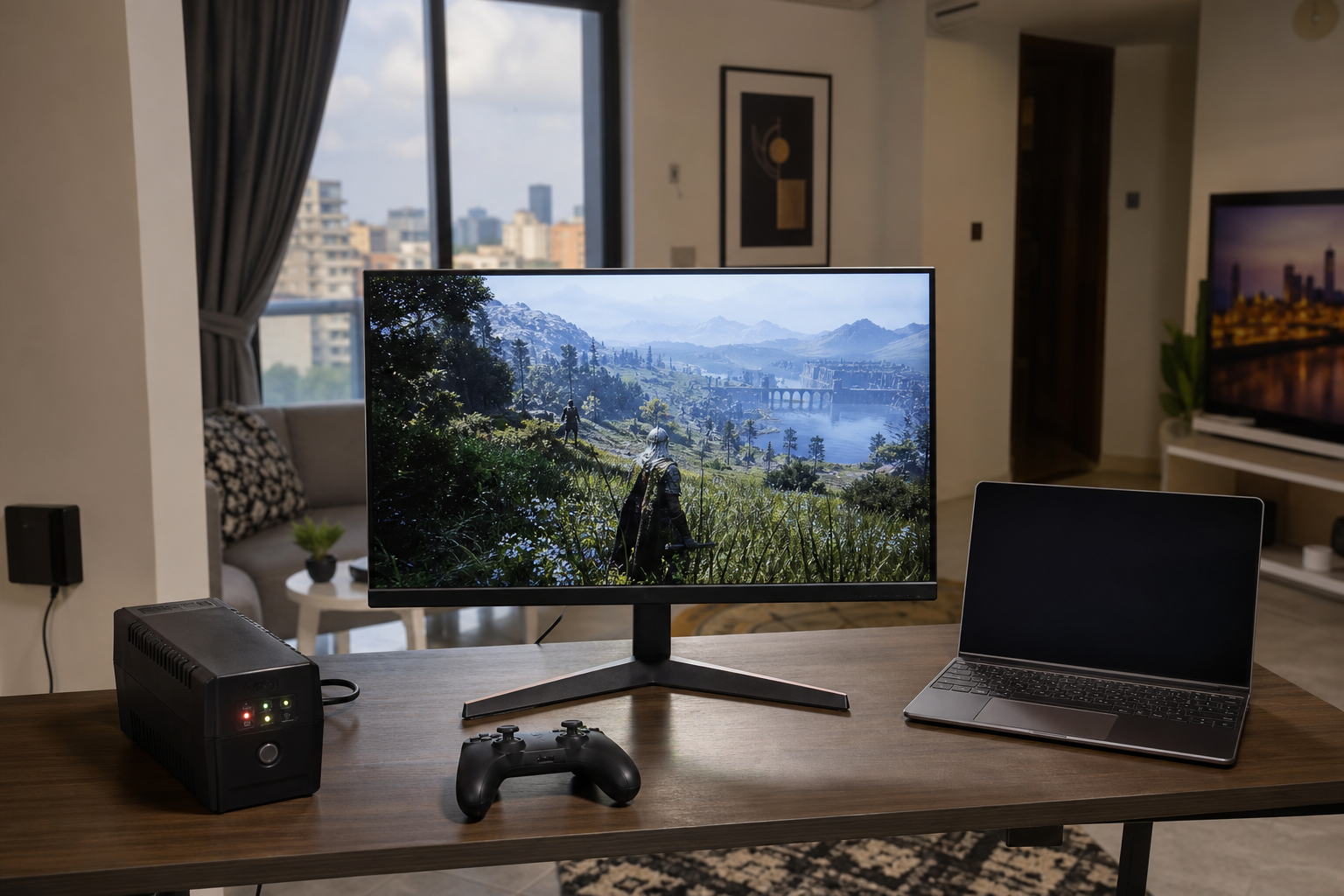
Desk gamers should verify ports, power protection, and device support before paying for a high-resolution monitor.
Nigeria availability, warranty and price context
As of August 12, 2026, the supplied Ogabassey catalog data does not confirm local stock for the Odyssey G8 G80HS. That means this article should not be read as Ogabassey stock confirmation, Samsung Nigeria launch confirmation, or a local warranty promise. Samsung’s U.S. launch material listed the 32-inch G80HS at $1,599.99 at launch, but that figure is not a Nigerian retail price. By the time an imported monitor reaches a Nigerian buyer, exchange rate movement, shipping, duty, reseller margin, and warranty handling can change the final cost sharply.
The safest buyer mindset is simple: treat the Odyssey G8 6K as a premium import-risk product until a local SKU, invoice route, warranty terms, and after-sales process are clear. Ask whether the seller is supplying an official regional unit, who handles dead pixels, who pays shipping if a panel fault appears, and whether repair parts are available locally. A monitor panel failure is not like replacing a common phone accessory; the repair cost can be high enough to ruin the value of the purchase.
Power is another practical point. A premium gaming display should not be connected directly to an unstable wall socket, cheap extension box, or generator line without protection. Budget for a quality surge protector or UPS, especially if the monitor will be used with a gaming PC. That extra spend belongs in the true cost of ownership, not as an afterthought.
If you want a confirmed Ogabassey monitor route today, start with the Ogabassey monitors category. The closest supplied catalog product is the Samsung C34G55T Curved Gaming Monitor, which is a different kind of gaming display: curved, ultrawide, and more conventional than the 6K Odyssey G8. It should not be treated as a direct substitute for 6K resolution, but it is relevant for shoppers who want a Samsung gaming-monitor direction without waiting for a new G80HS listing.
Gaming monitor or Samsung TV?
The Odyssey G8 6K is best understood as a desk-first monitor for a high-end PC, not a living-room TV replacement. A 32-inch screen can feel large on a desk, where your face is close to the panel and the sharpness of 6K is visible in text, creator apps, strategy games, photo editing, and dense open-world scenery. The same 32 inches can feel small in a shared living room, where a family may be watching football, YouTube, Netflix, DSTV Stream, or console games from across the room.
For a solo desk gamer or creator, the monitor case is strong if the PC is good enough. A 6K panel gives far more desktop workspace than 4K and can make fine detail look extremely clean. For a console-first buyer, the value is weaker. PlayStation 5 and Xbox Series X are better matched to a good 4K 120Hz display than to a 6K monitor whose biggest advantage they cannot fully use. A console gamer can still benefit from low latency, HDR support, HDMI 2.1, and a sharp 32-inch panel, but that does not automatically justify import-level pricing.
For a household screen, the TV argument remains strong. A larger Samsung TV gives more presence from the sofa, built-in TV apps, easier casual streaming, simpler family use, and often clearer local sales support. Ogabassey’s related watchlist on Samsung Micro RGB TV discounts and R85H Nigeria context is useful if your real decision is still a big-screen entertainment purchase rather than a desk monitor purchase.
Compatibility checks before buying
The first compatibility check is your graphics card or laptop output. Samsung’s headline modes are 6K at up to 165Hz and 3K at up to 330Hz. To make that meaningful, the source device, cable, and port all need to support the bandwidth. A seller saying “HDMI 2.1” or “DisplayPort 2.1” is not enough; ask for the exact model code, included cable, and refresh-rate confirmation with your intended device.
The second check is whether your PC can render the games you actually play at 6K. A monitor can accept a signal that your GPU cannot handle comfortably in demanding titles. Many buyers will end up using 4K, upscaling, lower settings, or the 3K high-refresh mode for fast games. That is not failure, but it changes the value argument. If you are mostly going to play at 4K or below, a strong 4K OLED gaming monitor may be the better visual experience because OLED contrast and pixel response can matter more than extra resolution.
The third check is USB-C. Samsung’s Odyssey OLED G8 models include USB-C with high power delivery, but the 6K G80HS is not the same product. Independent review coverage has flagged the absence of USB-C DisplayPort connectivity on the 6K G80HS, which matters for laptop users who want one-cable desk setup. If your work laptop depends on USB-C for display and charging, verify the connection path before payment. Adapters can work, but they add cost, clutter, and another failure point.
The fourth check is panel type. The 6K Odyssey G8 G80HS uses IPS LCD, not OLED. IPS can be sharp, bright, and practical for productivity, but it does not deliver OLED-style black levels or pixel response. If your priority is cinematic contrast, dark-room gaming, and extremely fast pixel transitions, Samsung’s 4K Odyssey OLED G8 or another OLED monitor may be a more satisfying buy than the 6K IPS model.
Spec and buyer-fit table
Buyer question
What Samsung’s 6K Odyssey G8 offers
Ogabassey buyer guidance
Screen size and resolution
32-inch 6144 x 3456 6K panel with very high pixel density
Excellent for a desk, creator tools, and close viewing; too small for most living rooms
Refresh rate
Up to 165Hz at 6K and up to 330Hz at 3K through Dual Mode
Useful for high-end PC gamers; console buyers should compare against 4K 120Hz value
Panel type
IPS LCD on the G80HS
Sharp and practical, but OLED alternatives can win on contrast and motion clarity
Ports
DisplayPort 2.1 and HDMI 2.1 are the key gaming inputs
Verify exact model, cable, GPU, dock, and laptop support before paying
USB-C productivity
Not the headline strength of the 6K model
Laptop-heavy buyers should consider whether a USB-C productivity monitor is smarter
Warranty and availability
International launch and Gamescom demo are confirmed
Ogabassey stock, local Samsung Nigeria warranty, and naira price are not confirmed in the supplied catalog
What the Crimson Desert demo proves, and what it does not
The Gamescom 2026 Crimson Desert demo is useful because it shows Samsung wants the Odyssey G8 judged with modern, visually ambitious games, not just productivity screenshots. Crimson Desert’s open-world scale, dense environments, and action combat are a sensible showcase for 6K sharpness and Dual Mode flexibility. It also supports the point Samsung has been making through 2026: new display features need game and studio support, not only hardware marketing.
But a trade-show demo does not prove Nigerian retail readiness. It does not prove your own PC can run a demanding game at 6K, it does not prove the monitor will be affordable locally, and it does not prove warranty handling will be smooth after import. For Ogabassey readers, the demo is a watch signal, not a buy-now signal. It tells PC gamers and creators to keep the G80HS on the shortlist, while telling console-first and family-screen buyers to slow down and compare alternatives.
If the monitor becomes locally available later, this article should be reconciled with the exact SKU, warranty route, and current Ogabassey product listing. Until then, buyers should avoid vague reseller listings that only say “Odyssey G8” because Samsung uses similar names across different panel types, sizes, and resolutions. G80HS, G80HF, G80SH, and G73SH are different products with different buyer roles.
Who should wait, buy, or choose something else?
Wait if your current PC is not built for high-end 4K gaming, let alone 6K. A display upgrade cannot replace GPU horsepower. Waiting also makes sense if you need official Nigerian warranty handling, predictable repairs, or a confirmed local invoice. Early-import pricing often rewards the seller more than the buyer.
Consider buying only if you are a desk-first user with a powerful gaming PC, a clear need for very high pixel density, and comfort with the warranty route. The best-fit buyer edits video, works with detailed timelines or images, plays PC games from close range, and understands that some games will still need upscaling or lower-resolution modes.
Choose something else if your main device is a PS5, Xbox, mid-range gaming laptop, office laptop, or streaming box. A good 4K 120Hz TV, a 4K OLED monitor, or a more affordable curved gaming monitor may feel better in daily use. If you are shopping around a whole setup, Ogabassey’s related guide on Acer’s Nitro 16 gaming laptop lineup for Nigeria buyers is a useful reminder that the PC and monitor should be planned together.
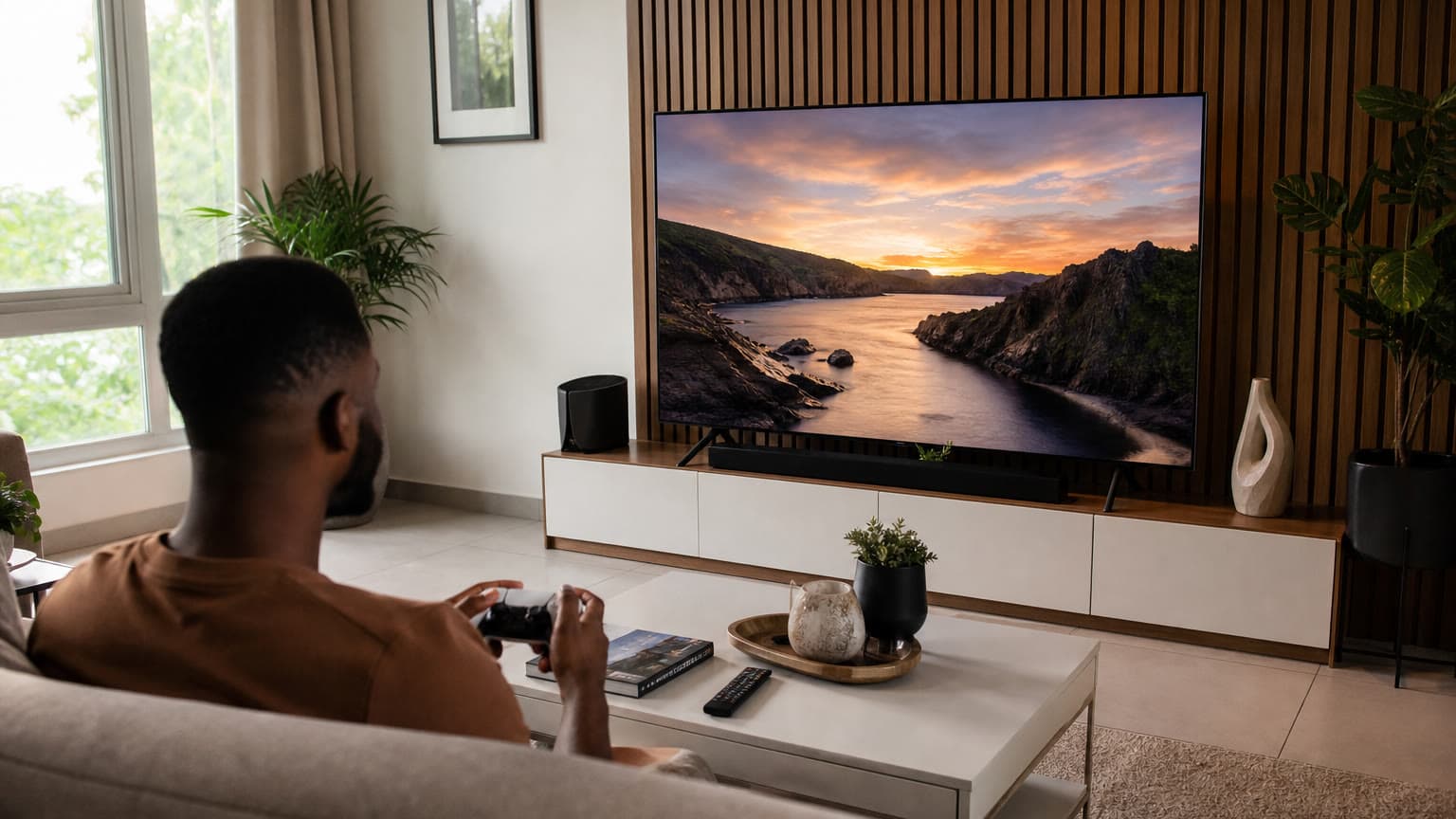
For shared viewing, a larger Samsung TV may still be the more practical buy than a specialist monitor.
FAQ
Is the Samsung Odyssey G8 6K available in Nigeria?
The supplied Ogabassey catalog data does not confirm local stock for the Odyssey G8 G80HS as of August 12, 2026. Treat any listing as something to verify carefully: exact model code, warranty route, return policy, power accessories, and who handles panel faults.
Should Nigerian console gamers buy the 6K Odyssey G8?
Most console-first buyers should be cautious. PS5 and Xbox Series X are better matched to a good 4K 120Hz TV or monitor. The 6K Odyssey G8 makes more sense if you also use a powerful PC and sit close to the screen.
Is 6K better than OLED for gaming?
Not automatically. 6K improves sharpness and workspace, while OLED often wins on contrast, black levels, and pixel response. If you play cinematic games in a dark room, OLED may be more satisfying. If you edit, multitask, and value fine detail, 6K has a clearer role.
Which monitor is best for work, gaming, or a laptop setup?
For work and laptop docking, prioritize USB-C, power delivery, text clarity, and stand adjustment. For gaming, prioritize refresh rate, response, adaptive sync, and the panel type you prefer. The Odyssey G8 6K is strong for sharpness and high-end PC gaming, but laptop users should verify USB-C needs before buying.
Should I buy a high refresh-rate monitor or a USB-C productivity monitor?
Buy the high refresh-rate monitor if gaming is the main job and your PC can drive it. Buy the USB-C productivity monitor if one-cable laptop docking, charging, video calls, and daily office work matter more. Some premium monitors do both, but the exact model matters.