Bassey John is a Performance Marketing Specialist at Ogabassey with cross-industry experience spanning e-commerce, gaming, and real estate. He focuses on paid acquisition, conversion-rate optimisation, and data-driven growth strategy, turning campaign performance into measurable revenue. At Ogabassey he writes about consumer technology, product buying guides, and the Nigerian gadget market to help shoppers make confident, informed decisions.
If you want the lower entry price for a 55-inch LG 4K TV, the LG NanoCell Smart TV is the easier value pick. Choose the LG QNED Smart TV if the higher 120Hz refresh rate matters more for gaming, motion and longer-term living-room use.
Decision summary
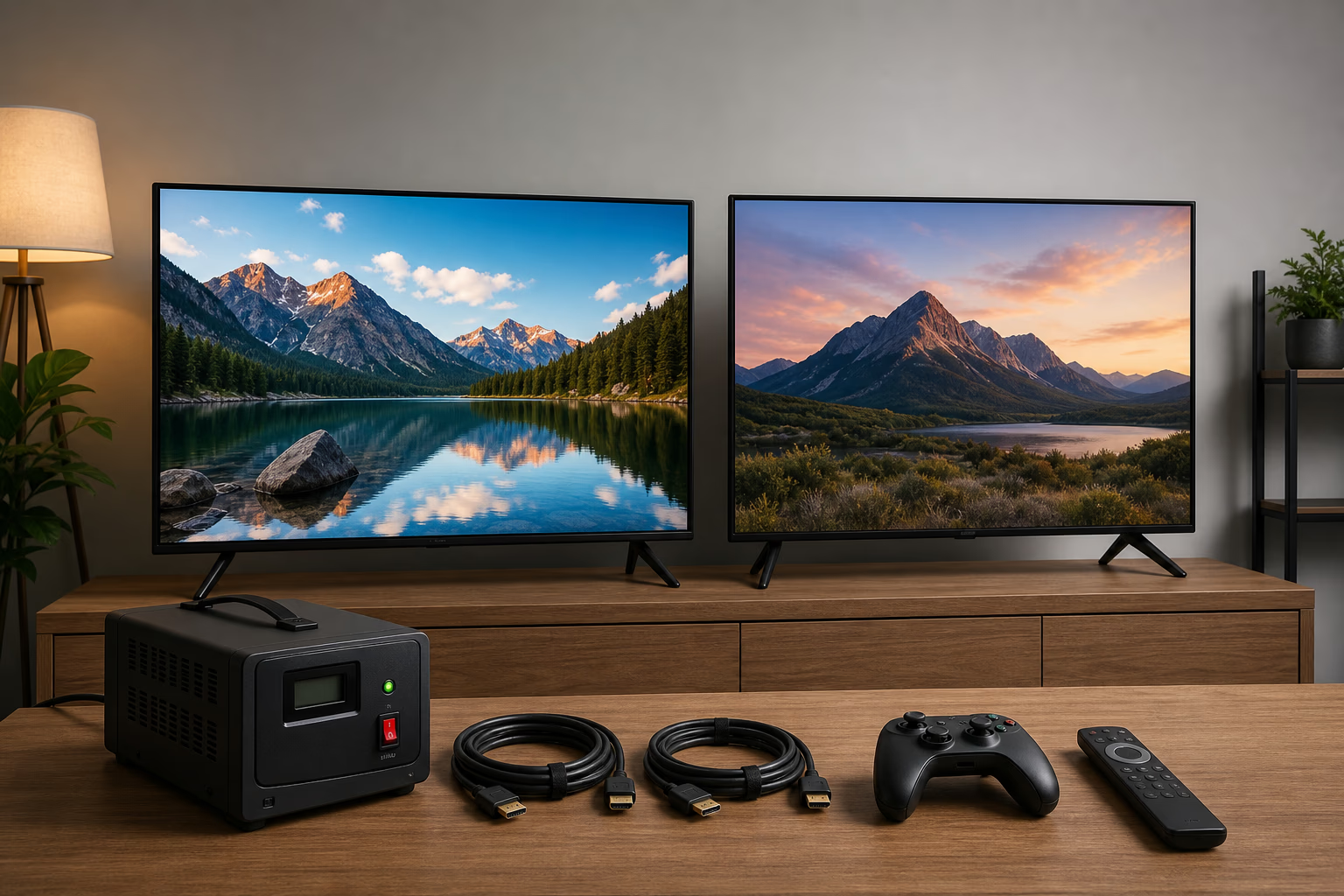
This comparison is based on Ogabassey catalog data reviewed on 14 June 2026, not hands-on lab testing. Both TVs are listed as 55-inch LG smart TVs with 4K UHD resolution, but they are not positioned the same way. The NanoCell listing starts at ₦600,000, uses a NanoCell display type and carries a 100Hz refresh rate in the available structured specs. The QNED listing starts at ₦960,000, uses a QNED display type and carries a 120Hz refresh rate.
That makes the first decision simple: if your budget is tight, or the TV is mainly for movies, YouTube, football, DStv, family viewing and streaming apps, NanoCell is the more sensible starting point. If the TV will sit in the main lounge, handle a current-generation console, or be used by people who notice motion smoothness in sports and games, QNED has the stronger spec signal because of its 120Hz panel listing.
The price gap is not small. Using the catalog starting prices, the QNED model costs ₦360,000 more than the NanoCell model before any checkout, variant or availability confirmation. That difference can buy a stabilizer, wall mount, streaming box, soundbar contribution or part of a console budget. So the right answer is not simply “buy the better TV.” The better buy is the one whose extra cost is visible in your actual room, content and devices.
Quick comparison table
Decision point
LG NanoCell Smart TV
LG QNED Smart TV
Buyer meaning
Ogabassey listed starting price
₦600,000
₦960,000
NanoCell is the lower-cost route into a 55-inch LG 4K TV.
Screen size
55 inches
55 inches
Both target the same medium-to-large living-room size.
Resolution
4K UHD
4K UHD
Both should be judged more by panel family, refresh rate, apps and setup than by resolution alone.
Display type
NanoCell
QNED
QNED is the higher-positioned panel family in this catalog comparison, but exact model variant still matters.
Refresh rate
100Hz
120Hz
QNED has the stronger motion and gaming spec on paper.
Catalog condition
New
New
Both are listed as new products, but confirm exact package contents before payment.
Stock indicator in snapshot
0 shown in product row
0 shown in product row
Do not treat this as live availability; confirm availability before checkout.
Best fit
Budget-conscious 55-inch 4K buyers
Gaming, sports and main-room buyers who can justify the higher price
Your room and devices should decide the winner.
The key differences in the table are price and refresh rate. The NanoCell model is cheaper by catalog starting price. The QNED model has the 120Hz refresh-rate advantage. Other important purchase checks, including exact webOS version, HDMI port count, tuner type, HDR formats, remote type, warranty handling and delivery status, should be confirmed from the selected variant before checkout because they are not fully specified in the provided catalog snapshot.
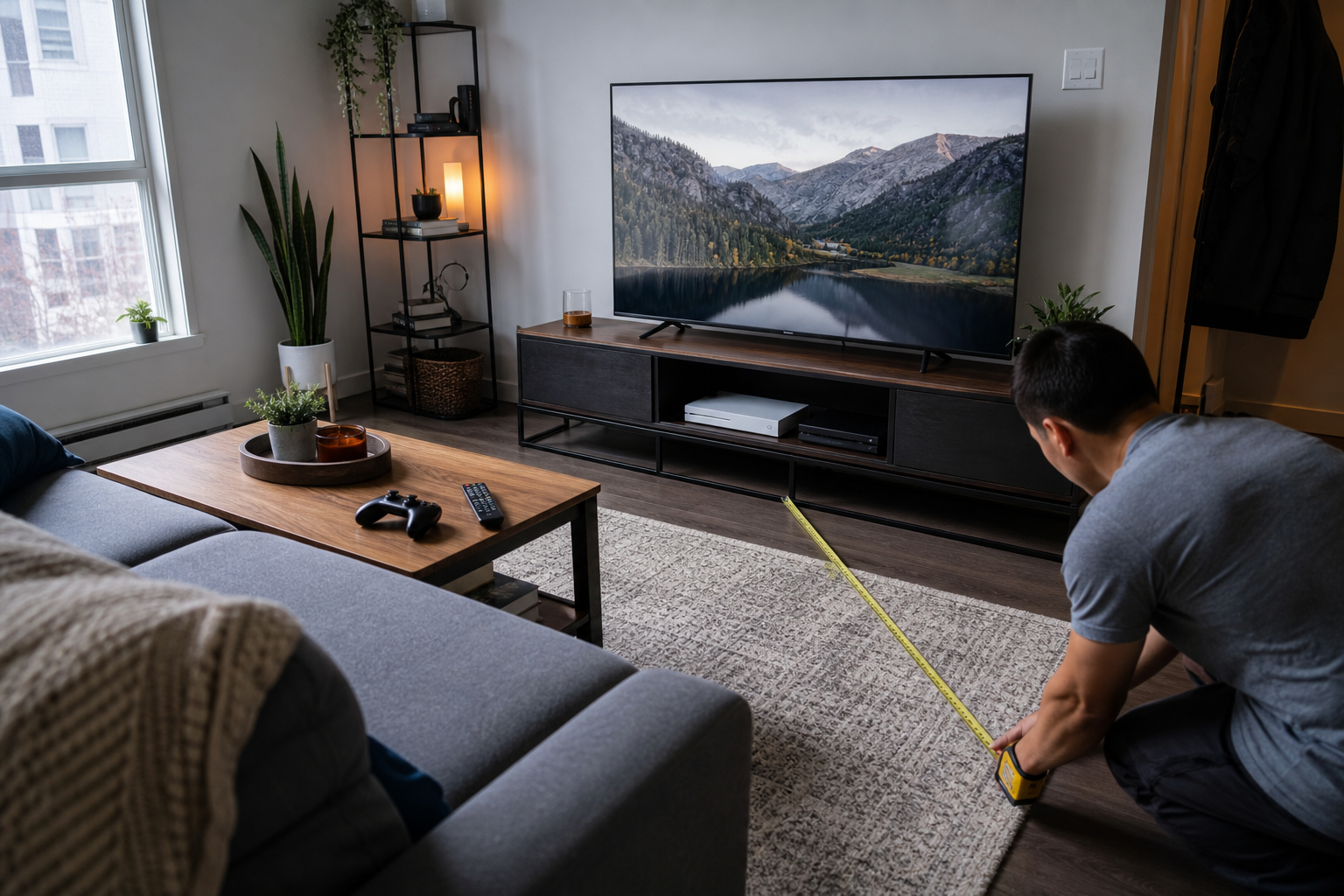
Room size, viewing distance and connected devices should shape the NanoCell versus QNED decision.
Price and value for Nigerian buyers
At ₦600,000, the LG NanoCell Smart TV is the value anchor in this comparison. It is the one to check first if you are replacing an older 43-inch or 50-inch TV and want the size upgrade to 55 inches without pushing too far into premium-TV pricing. It also leaves more of the budget for practical Nigerian setup costs that buyers sometimes forget: surge protection, wall mounting, HDMI cables, a streaming subscription, a compact UPS for router continuity, or a better sound system.
At ₦960,000, the LG QNED Smart TV needs to earn its extra cost. Its clearest catalog-backed advantage is the move from 100Hz to 120Hz. That matters most when the TV is used for fast motion: football, action films, console gaming and quick camera pans. It can also matter if you expect to keep the TV for several years and want the panel spec to age better with newer devices.
For a bedroom, guest room, small apartment lounge or family TV where most viewing is compressed streaming, the extra ₦360,000 may not be visible enough every day. For a main living room where people sit farther back, watch sports together and connect consoles, the QNED upgrade is easier to defend. The practical rule is this: buy NanoCell when the TV is one part of a wider setup budget; buy QNED when the TV itself is the centrepiece.
Before paying for either model, use the product pages to confirm the selected item price and availability: the NanoCell product page and the QNED product page are the right internal checks. The catalog snapshot used for this draft shows stock quantity as 0 for both rows, so a human buyer should not assume immediate stock from this article alone.
Performance and daily use
Both TVs are listed as 4K UHD 55-inch LG smart TVs, so the everyday experience will depend on more than resolution. A 55-inch 4K TV is a strong fit for many living rooms because it gives enough size for movies and football without becoming difficult to place. In a small room, however, 55 inches can feel large if the sofa is very close. In a deeper lounge, it can feel more balanced than a 43-inch TV, especially for families watching from different seats.
The NanoCell model’s 100Hz refresh rate is already above the basic 60Hz level many entry TVs carry, based on the provided structured specs. That gives it a useful motion baseline for sports and general TV. The QNED model’s 120Hz refresh rate is the better spec for fast movement and current gaming consoles, provided the selected variant also has the required HDMI features. Because HDMI port count and HDMI standard are not listed in the snapshot, buyers should ask directly before treating the QNED as a complete console-first purchase.
For streaming apps, both are described as LG smart TVs, but the snapshot does not name the operating-system version or app support list. That means you should confirm the exact smart TV platform, Netflix and YouTube support, local app needs, screen mirroring options and included remote before checkout. If your household depends on a specific app, do not assume support from the smart TV label alone.
Power stability is another local consideration. Neither listing provides power-consumption data, voltage tolerance or surge-protection detail. In areas with unstable supply, the more useful buyer move is to budget for a quality surge protector or stabilizer and keep receipts and warranty documents together. A more expensive TV does not remove the need for good power protection.
Display, build and room fit
The display distinction is the heart of this comparison. NanoCell and QNED are different LG panel families, and in this catalog pair QNED is the higher-priced option. The provided data does not include peak brightness, local dimming information, contrast measurements, HDR format support or viewing-angle measurements, so this draft should not claim lab-level picture superiority. What can be said safely is that QNED carries the stronger refresh-rate spec and the higher catalog price, while NanoCell carries the lower price and same listed size and resolution.
Room lighting should influence your choice. If the TV will be used mostly at night or in a controlled-light room, the cheaper NanoCell may satisfy most viewers. If the TV will be used in a brighter living room, you should ask for exact model details and brightness-related specifications before buying either one. The product family name alone is not enough to guarantee performance in a sunlit room.
For room size, 55 inches is usually a practical middle ground for Nigerian apartments and homes: large enough for football and movies, not as demanding as 65 inches for wall space or TV-console width. Measure the stand, check whether the legs fit your furniture, and confirm wall-mount compatibility if you plan to mount it. The snapshot does not list dimensions or weight, so furniture fit should be checked before payment.
Build details such as bezel finish, stand design, cable routing and remote type are also not included in the available product specs. If appearance matters in your lounge, ask for current product photos of the exact variant, not just a generic catalog image. This is especially important where several LG models share similar names but differ by year, region, remote or port configuration.
Before checkout, confirm ports, power protection, remote, warranty and exact model variant.
Gaming, sports and console fit
For gaming, the QNED model is the stronger candidate because the snapshot lists 120Hz refresh rate versus 100Hz for NanoCell. That does not automatically prove full console readiness, but it is the better starting point. Buyers with a PlayStation 5, Xbox Series X or a gaming PC should confirm HDMI 2.1 support, 4K at 120Hz handling, variable refresh rate support and low-latency mode before deciding. Those details are not present in the supplied catalog data, so they should be treated as checkout questions.
For football and fast sports, 120Hz is also the more attractive number. Motion processing can vary by exact model, but a higher refresh-rate panel gives the QNED listing a stronger on-paper advantage. If sports viewing is the main family use case and the budget can stretch, QNED is the more future-friendly option. If sports are occasional and the TV is mainly for everyday streaming, NanoCell keeps the cost more controlled.
For older consoles, decoder boxes, basic streaming sticks and standard HDMI devices, both TVs should be evaluated around port count and placement. The snapshot does not list ports, so ask how many HDMI ports are available and whether one is ARC or eARC for a soundbar. This matters more than many buyers expect because a TV can quickly run out of ports once you connect a console, decoder, soundbar and streaming device.
Trust, warranty and availability checks
Because both products are catalog listings rather than hands-on Ogabassey reviews, the safest buying process is verification-led. Confirm the exact model number, selected variant, package contents, included remote, wall-mount policy, warranty terms, return conditions and live availability before checkout. The product descriptions themselves advise buyers to confirm exact model, variant, package contents, selected item price and live availability.
Warranty and support matter more on a 55-inch TV than on a small accessory because returns, transport and panel issues are more complicated. Keep the invoice, inspect the screen on delivery or pickup, test HDMI ports early, check Wi-Fi setup, and confirm that the remote and stand accessories are complete. If the TV is being installed by someone else, take time to test it before the installer leaves.
For category browsing, the wider LG TVs catalog is useful if you want other LG screen sizes or panel families. The broader Smart TVs section helps if you are open to other brands and sizes. If you are comparing beyond LG, the Samsung TVs category is the natural cross-shop, especially for buyers asking whether Samsung or LG is better value.
Who should buy each option?
Buy the LG NanoCell Smart TV if...
Buy NanoCell if your target is a 55-inch LG 4K TV at the lowest listed price in this pair. It is the better fit for buyers who care about size, streaming and brand familiarity but do not want to spend almost ₦1 million before accessories. It also makes sense for a second lounge, bedroom, family room, rental apartment or budget-conscious upgrade from a smaller TV.
NanoCell is also the safer value choice if you are not connecting a current-generation console or if you mostly watch regular TV, YouTube, Netflix, football highlights and movies. Its 100Hz catalog refresh-rate listing is enough to make it more interesting than a very basic panel, but the lower price is the real reason to choose it.
Buy the LG QNED Smart TV if...
Buy QNED if the TV is your main screen and you want the stronger listed refresh rate. The 120Hz spec gives it the clearer gaming and sports angle, and the QNED display family positions it as the more premium option in this comparison. It is the better pick for buyers who will notice motion, use consoles, host match days or keep one TV as the centre of the living room for years.
The QNED is not the automatic pick for everyone because the price jump is meaningful. It becomes the better buy when the extra ₦360,000 does not prevent you from buying the supporting items that protect and complete the setup: stable power protection, proper mounting, sound, HDMI cables and any streaming devices you need.
Alternatives to consider
If both models feel too expensive, consider stepping down in size or checking a different LG model. Ogabassey’s earlier guide to the LG UHD 4K HDR Smart TV 43-inch buying check is useful for buyers who want a smaller room fit and a lower expected spend. A 43-inch TV can be more sensible in bedrooms, smaller apartments and spaces where a 55-inch panel would dominate the wall.
If you are brand-flexible, Samsung is the obvious alternative path. The point is not that Samsung is always better or LG is always better; the useful question is which brand gives you the right size, panel type, refresh rate, warranty path and live price at the time you are ready to buy. Compare exact models, not brand names alone.
Buyers with gaming as the main use case should also compare against dedicated gaming-friendly TVs with clearly listed HDMI 2.1 and 4K 120Hz support. The QNED listing has the refresh-rate advantage here, but the missing port details mean it still needs confirmation before being treated as a console-first recommendation.
Verdict
The LG NanoCell Smart TV is the better value pick for most 55-inch 4K buyers because it starts at ₦600,000, matches the QNED on listed size and 4K UHD resolution, and leaves more room in the budget for setup essentials. The LG QNED Smart TV is the better performance-leaning pick because it moves to a QNED display type and a 120Hz refresh rate, compared with NanoCell and 100Hz on the cheaper model.
For most homes, start with NanoCell unless gaming, sports motion or a premium main-room setup justifies the upgrade. Choose QNED when the 120Hz refresh-rate advantage will be used often enough to make the ₦360,000 price gap feel practical rather than aspirational. Either way, confirm live availability, exact model variant, HDMI ports, app support, warranty terms and package contents before checkout.
FAQ
Which TV size and panel should I buy?
For many living rooms, 55 inches is a strong middle size. In this comparison, choose NanoCell if price matters most and QNED if the TV is for gaming, sports and main-room use. Confirm the exact model, ports and brightness-related specs before payment.
Is LG NanoCell or LG QNED better value?
NanoCell is better value if you want the lower listed price: ₦600,000 versus ₦960,000 for QNED in the catalog snapshot. QNED becomes better value only if you will use its stronger 120Hz refresh-rate spec often enough.
Is Samsung or LG better value for a smart TV?
Do not decide by brand alone. Compare exact screen size, panel type, refresh rate, warranty path, port list and live price. LG is the focus here, but Samsung alternatives are worth checking if they offer a stronger exact-model deal at checkout.
What should I confirm before buying either LG TV?
Confirm live availability, final price, exact model number, HDMI ports, smart TV app support, tuner type, included remote, warranty terms, return process, package contents and whether the TV needs a stabilizer or wall-mount accessories for your setup.