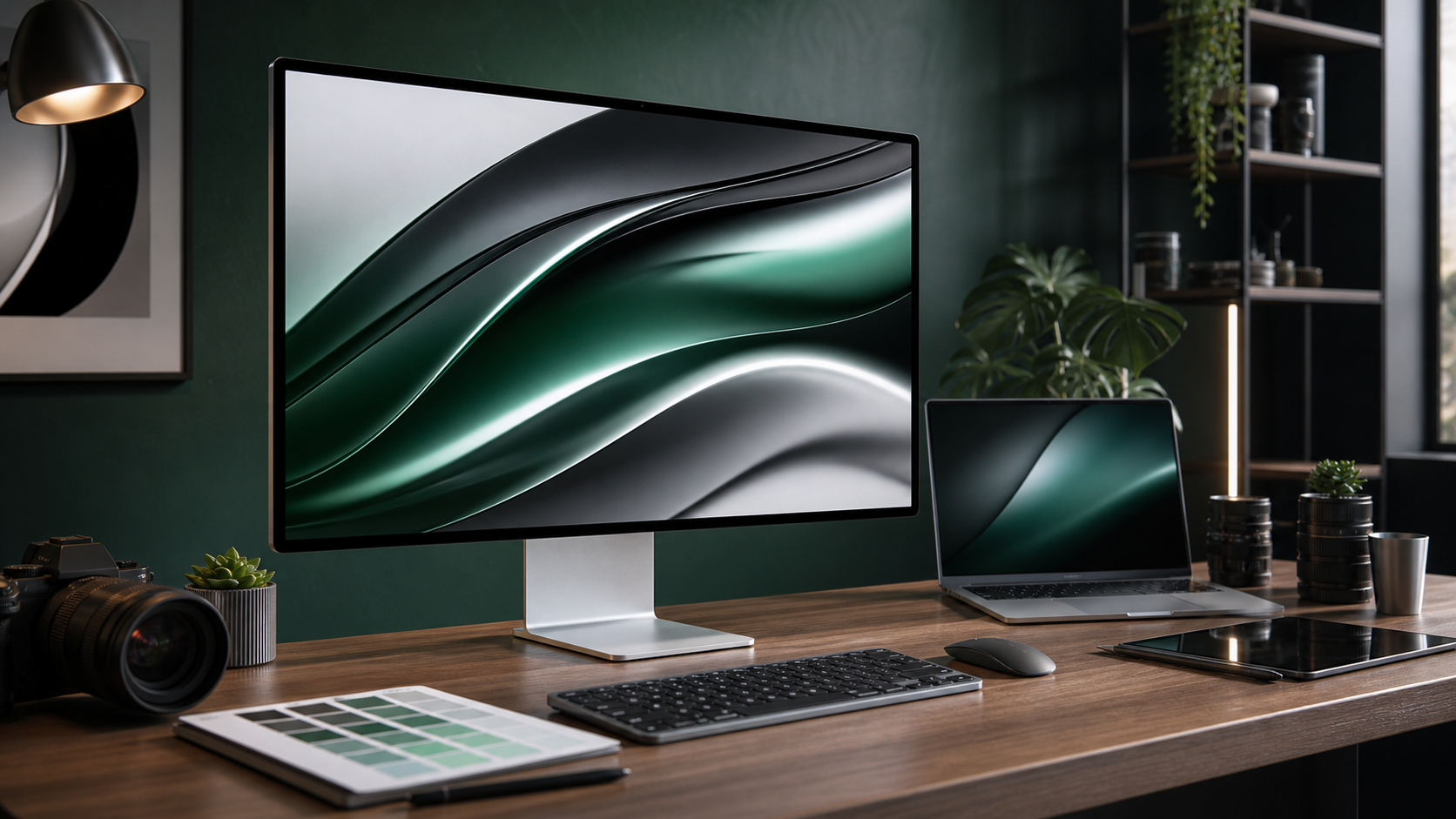
When Apple announced a refresh to the Studio Display on March 3, 2026, the creative community held its breath for ProMotion or Mini-LED. Instead, Apple took a "if it ain't broke, don't fix it" approach to a fault.
While the new Studio Display XDR (the $3,299 beast) stole the headlines with its 120Hz panel, the standard 2026 Studio Display remains a more subtle evolution. If you’re staring at your 2022 model and wondering if it’s time to trade up, let’s look at the numbers.
2022 vs. 2026: The "Spot the Difference" Edition
At first glance, these monitors are identical. They share the same aluminum chassis, the same 5K resolution, and even the same starting price of $1,599. However, the internal "brain" and the ports have seen a significant logic board swap.
Feature | Studio Display (2022) | Studio Display (2026 Refresh) |
Panel Type | 27" 5K IPS LCD (60Hz) | Same (60Hz IPS LCD) |
Internal Chip | A13 Bionic | A19 Chip |
Connectivity | 1x TB3, 3x USB-C (10Gbps) | 2x TB5, 2x USB-C (10Gbps) |
Camera | 12MP Center Stage | 12MP with Desk View Support |
Audio | 6-Speaker System | 6-Speaker (30% Deeper Bass) |
Max Charging | 96W | 96W |
The Reality Check: The most disappointing news for many is that the refresh rate remains locked at 60Hz. If you want that buttery-smooth scrolling found on the MacBook Pro, Apple now expects you to pay double for the XDR model.
What Actually Changed?
1. The Jump to Thunderbolt 5
This is the biggest functional win. The 2026 model now features two Thunderbolt 5 ports. This allows for massive bandwidth (up to 120Gbps), meaning you can finally daisy-chain a second 5K display or high-speed RAID storage directly through the monitor without bottlenecking your Mac's single port.
2. The A19 Brain & Camera
The move from the aging A13 (iPhone 11 era) to the A19 chip isn't just for show. It powers a significantly better image signal processor (ISP) for the webcam. While it's still a 12MP sensor, the low-light grain is noticeably reduced, and it now natively supports Desk View, which uses the wide-angle lens to show a top-down view of your workspace during calls.
3. Thumping Audio
Apple claims the 2026 woofers provide 30% deeper bass. In real-world testing, this makes the monitor feel even more like a standalone media hub. It’s arguably the only monitor on the market where you genuinely don't need external speakers for professional video editing or casual music listening.
The Mid-to-High-End Landscape
How does the refreshed "Standard" model look against the 2026 competition?
Samsung ViewFinity S9 (2026 Edition): Samsung has updated their 5K competitor with a matte finish as standard. It remains the better "budget" choice if you need a height-adjustable stand without paying the $400 "Apple Stand Tax," but it still lacks the build quality and integration of the Studio Display.
BenQ MA270S: Specifically designed for Mac users, this 5K panel mimics macOS color presets perfectly. It’s significantly cheaper than Apple’s offering, though it feels like a "display only" rather than the "all-in-one hub" (camera/mic/speakers) that the Studio Display provides.
Dell UltraSharp 32" 6K: For roughly the same price as a specced-out Studio Display, Dell offers 6K resolution and a much larger canvas. However, at 218 PPI, Apple’s 27-inch 5K remains the "Goldilocks" zone for macOS scaling.
The Verdict: To Upgrade or to Wait?
Don't Upgrade if:
You already own the 2022 Studio Display. The visual experience of the panel itself is identical. Unless you are desperate for Thunderbolt 5 daisy-chaining, there is no reason to spend $1,599 for the same 60Hz experience.
You are an Intel Mac user. The 2026 model is the first to officially drop support for Intel-based Macs, requiring Apple Silicon to function.
Do Upgrade if:
You are still using an aging 27-inch iMac or a 4K monitor. The jump to 5K is life-changing for text clarity and timeline space in DaVinci Resolve or Final Cut.
Your workflow requires daisy-chaining. The dual Thunderbolt 5 ports turn this monitor into a legitimate high-speed workstation hub.
Our Thought
The 2026 Studio Display is less of a "Version 2.0" and more of a "Version 1.2." It remains the best looking, most integrated monitor for the average Mac user, but the lack of ProMotion at this price point in 2026 is a bitter pill to swallow.
Related reading: Everything We Know About Apple’s Creator Studio.